
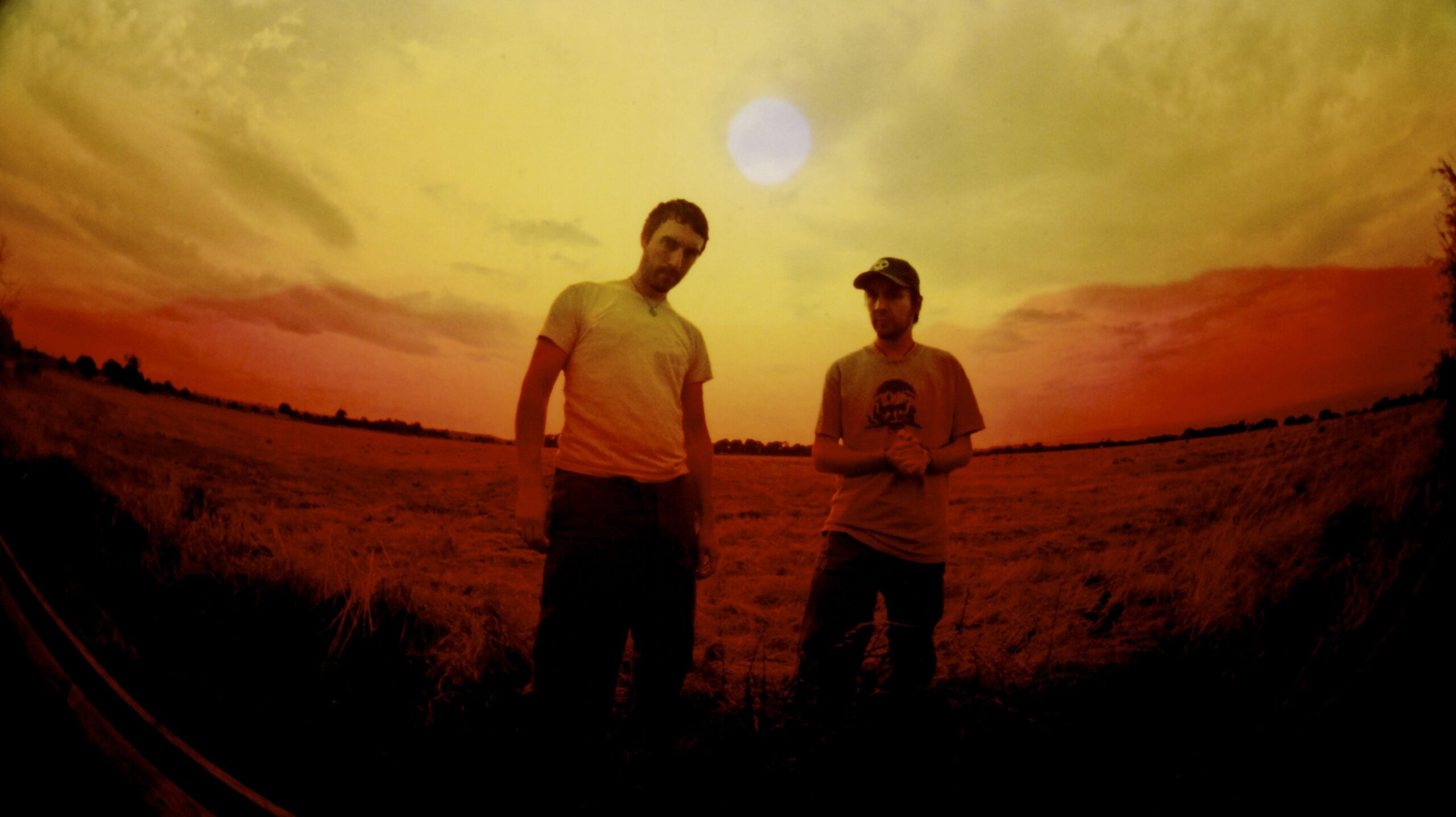
After thirteen years away, the Scottish duo resurfaces from the shadows with its darkest and most impactful album yet. Between cryptic publicity campaigns, industrial beats and references to Dante and Aleister Crowley, brothers Michael Sandison and Marcus Eoin deliver a fifth record as beautiful as it is unsettling.
On April 7, social networks ignited: VHS tapes bearing the hexagonal logo of Boards of Canada, randomly mailed to a handful of fans by their Warp label, appeared like relics from another time. Thirteen years after Tomorrow’s Harvest (2013), a spectral and cinematic album pierced by anxiety-drone, which had fascinated as much as it divided, would the Scottish duo finally be plotting a return? Hard not to think so. The video contained on the VHS, with its deteriorated grain, its lugubrous synths, the Greek christogram, its references to American televangelists, its inverted sample of The Elegants’s Little Star (1958) or this excerpt from an advertisement for the Moody Bible Institute, read like a coded message meant to restart the fantasy machine.
Boards of Canada had indeed returned to service and had something to tell us. A week later, on April 14, Warp hammered the point with a wildposting campaign: faces of children with glazed eyes, surmounted by the famous hexagon, a direct reference to their beginnings and their Hexagon Sun studio. Then came Tape 5, the first track unveiled accompanied by a video, followed by a pared-down tease: Inferno. 18 tracks. 70 minutes. 2xLP, CD, digital. Release on May 29, 2026.
A lo-fi and retro-futurist aesthetic
Since their true debut album, Music Has the Right to Children in 1998, the two brothers have built a parallel universe immediately identifiable by their melodies that are both syrupy and grainy, their soft yet cutting hip-hop beats, their manipulated voices drawn from 1970s educational documentaries, all put through a lo-fi and retro-futurist aesthetic that has become their signature. Subtle to the point of erasure, absent from media circuits as well as clubs, citing as much Joni Mitchell as the Beatles, Meat Beat Manifesto or My Bloody Valentine, Boards of Canada forged in five albums a language that nourished the mutations of contemporary hip-hop as much as folk, the contemplative offshoots of electronica, or the nostalgic obsession of vaporwave. Yet, it is difficult to classify Boards of Canada or tie them to a single school. Many have failed trying to fit them into ambient-house, folktronica, IDM, the psychedelic renewal, or, of course, hauntology. As if the duo carefully avoids all scholarly discourse surrounding their music to let it unfold, breathe, and express itself.
We can say it: Inferno, their fifth album in thirty years of existence, inspired by Dante’s universe, cults and mind control, is another piece to add to the Boards of Canada puzzle. With a return of saturated and manipulated guitars in shoegaze fashion, complex, sharp and metallic rhythms, vocal samples drenched in vocoder and atmospheres lost in mist, as dark as radiant. A grand Boards of Canada, torn between worry and pastoral, between the pastoral and the mathematical, between the experimental and the pop, between disappearance and life, like a convergence of their two landmark albums, Music Has the Right to Children (1998) and Geogaddi (2002). Among the 18 tracks, some following in the footsteps of Prophecy At 1420 Mhz, one of the first pieces to be revealed, the duo blurs the lines like never before: troubled ambient, weightless drones, tweaked zithers, samples of Hare Krishna and Aleister Crowley, redirected oriental melodies, imaginary dialogues and nods to the Cocteau Twins (notably their collaboration with Harold Budd).
A lot has been said and written, often with a bias toward intellectual references, about Boards of Canada, as if the universe laid out by the duo deserved to be dissected. But relatively little, in the end, about their pop and universal potential, about their sense of rhythm as well as melodies, their obsession with making music that is so complex in its structure approachable, their taste for the occult and their ability to favor atmosphere over commentary. Inferno will not help us pierce the mystery surrounding Boards of Canada. And that is a good thing.
Inferno (Warp/Kuroneko). Released May 29.
