
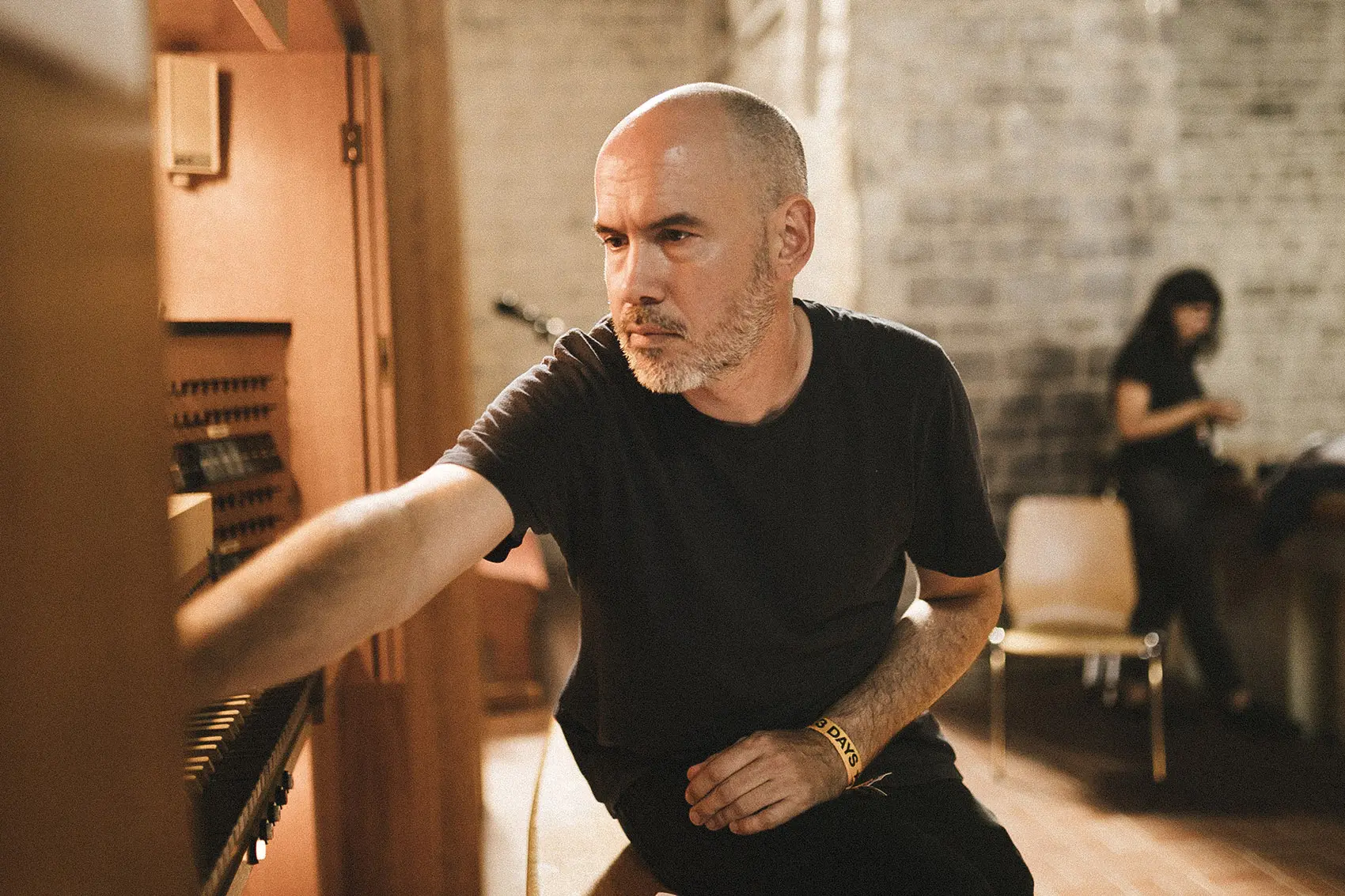
After “Nachthorn” in 2022, a tribute to dub techno, Maxime Denuc signs a hypnotic album where the baroque repertoire meets the trance of the nineties.
There is something evanescent, almost unsettling, in Maxime Denuc’s music. The tracks seem to float in a trance held in a precarious balance, somewhere between textured ambient and minimal techno when it unravels into dub. Since discovering the organ in 2010, on the occasion of a commission around Bach, the composer known from the duo Plapla Pinky began to weave it into his composing process until it became his instrument of choice.
“With Plapla Pinky we decided to record an electronic EP in which the organ would generate the majority of the material. The organist Cindy Castillo, with whom we produced Appel (2015), introduced us to the Baroque repertoire and I then continued this work solo with Solarium, in 2019, a long drone of three hours intended to be played in after techno sets,” explains the musician. Then, during Covid, I felt like composing an album for MIDI organ. I was welcomed by the Sankt Antonius church and I composed Nachthorn (2022) without a very precise aim. The album did better than expected, and the organ gradually became my main instrument without me really noticing.”
If Nachthorn aimed to be a homage to acid house and to the raves, through its way of using repetition and weaving deftly between minimal techno and dub, Club Imperiale borrows its title from the name of a famous Italian club from the 1990s in Tuscany. And it dreams of a hypnotic and naive revisited trance, one that evokes the Italian labels DFC or UMM, Sueño Latino, or that ecstasy-soaked anthem LSD by Hallucinogen.
Let Baroque and Electronic Music Converse
“For this album, I was looking for another source of inspiration that would allow me to push the harmonic language further. It was a press article highlighting the trance aspects of Nachthorn that set me on this path. I had always loved that Mediterranean trance for its harmonic power, its arpeggios, its rhythmically sequenced chords, and I found that the organ, with its particularly clean attacks and its multitude of sound colors, could convey these ideas.” Entirely composed on the organ, using a complex computer-controlled process, in the Saint-Antoine Church in Düsseldorf and over the long course of a year, Club Imperiale succeeds in the bet of making baroque and electronic music speak to each other in “a point of creative symbiosis between the Catholic Church and the ecstatic dance floors of the early 1990s”.
“Many things bring these musics closer, notably their relationship to repetition and development,” the producer continues. “One can start from a very simple motif, from a harmonic progression, and let it evolve for a long time. This is a central idea in electronic music, at least often among the artists who influence me.” Placed in high regard by Richie Hawtin or Modeselektor, heard even on Chanel runways, Maxime Denuc’s music resonates with influences from Carl Craig, GAS, Richie Hawtin or Maurizio. Through his penchant for textures, Club Imperiale reaches its apex between ambient and minimal, trance and baroque in a “rave-rie” inhabited by poetry and dreaminess, whose beauty leaves one breathless.
Club Imperiale (Light-Years/!K7). Release on September 11. Live at Saint-Eustache Church, Paris, on December 3.
