
Few films today dare to say so much with so little. “Yesterday I Conquered Thebes,” Gabriel Azorín’s debut feature, arrives in theaters after screening at the Venice Film Festival, where it was one of the most acclaimed titles of its edition. It is described as a “historical,” “ghostly,” and “aquatic” film, and above all as a work about male friendship across the ages. The title itself comes from a line exchanged by Matt Damon and Casey Affleck in Gus Van Sant’s Gerry (2002).
The film follows a group of friends who arrive at the Roman baths in Ourense. There, amid baths and conversations that seem ordinary, we come to understand the bonds that connect them. They talk about video games, about their plans, about what worries them. The dialogue feels very natural, almost voyeuristic, as if we were listening to a group of friends who do not realize a camera is in front of them. Gradually, these conversations begin to bear a heavier weight.
After a spectacular drone shot reveals the ruins and the baths from above, a tour guide explains the site to a group of visitors. Meanwhile, the friends wade into the water. And that is when the film begins to hint that there is another story, set many centuries earlier.
Azorín makes that temporal leap feel surprisingly natural. There are no flashbacks or grand explanations: simply, the film cuts and we are in another time. The characters change, but the space remains. The director’s reference to the cinema of António Reis and Margarida Cordeiro and to their “stratigraphies” is especially interesting here: different times can coexist in a single image without one needing to be presented as the memory of the other.
It is the small details that pull the thread of the story. The astrology app the young contemporaries consult finds its echo in the scene in which one of the soldiers meticulously ties his sandals. The friendships are the same; the conversations and the landscapes, ultimately, are too. Perhaps the only criticism that could be leveled at the film is that it is a touch too submerged: after a while you want to come up for air, you feel wrinkled and cold.
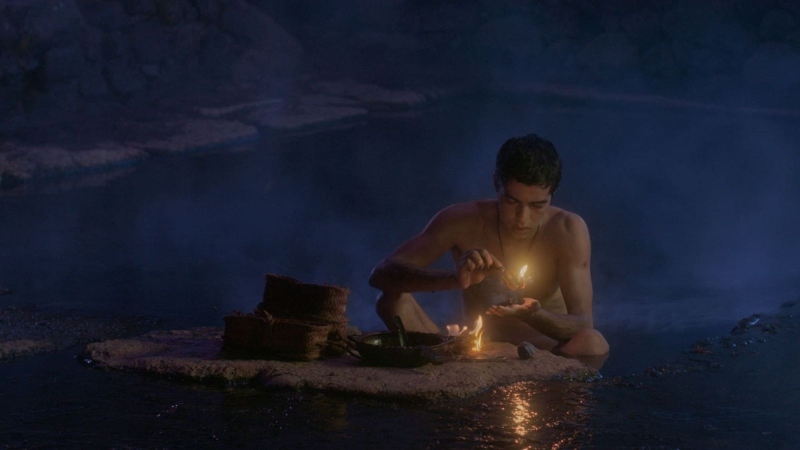
Still, “Yesterday I Conquered Thebes” is filled with moments of enormous beauty. There is special care given to the nocturnal baths, when the valley’s darkness is so dense that the characters are barely distinguishable. There are also meticulously crafted images of the bodies of the Roman soldiers, including the amputated leg of one of them, and a beautiful scene in which someone manages to keep a small fire alight underwater. Little by little, the scenes imprint themselves on memory.
The dialogues in the second part, moreover, are in Latin, and it is breathtaking to hear the actors sustain such long conversations with a naturalness that makes you forget you are watching a film. In fact, the entire movie is spoken in Portuguese and Latin, something that contributes to that strange sensation of watching two distant moments in history that nevertheless speak of very similar things.
“Yesterday I Conquered Thebes” tells very little: a few friends arrive at the baths, bathe, talk, and one of them leaves. Afterwards, Roman soldiers do the same. But the film turns that anecdote into a meditation on masculine friendship and the emotions—silent, yet here brought to the surface—that sustain it. A fun detail: a friend told Azorín that the film was science fiction because it showed “men talking about their emotions.” Perhaps, in a way, it is.
In the final minutes, the two eras meet in a lovely, almost Tarkovskian fashion. Perhaps “Yesterday I Conquered Thebes” is a historical film because it suggests that history repeats itself and speaks not only of what changes but also of what does not. It is a preciosity-driven, hypnotic film that manages to make an ordinary afternoon in a bathhouse feel like it contains two thousand years of history.
