
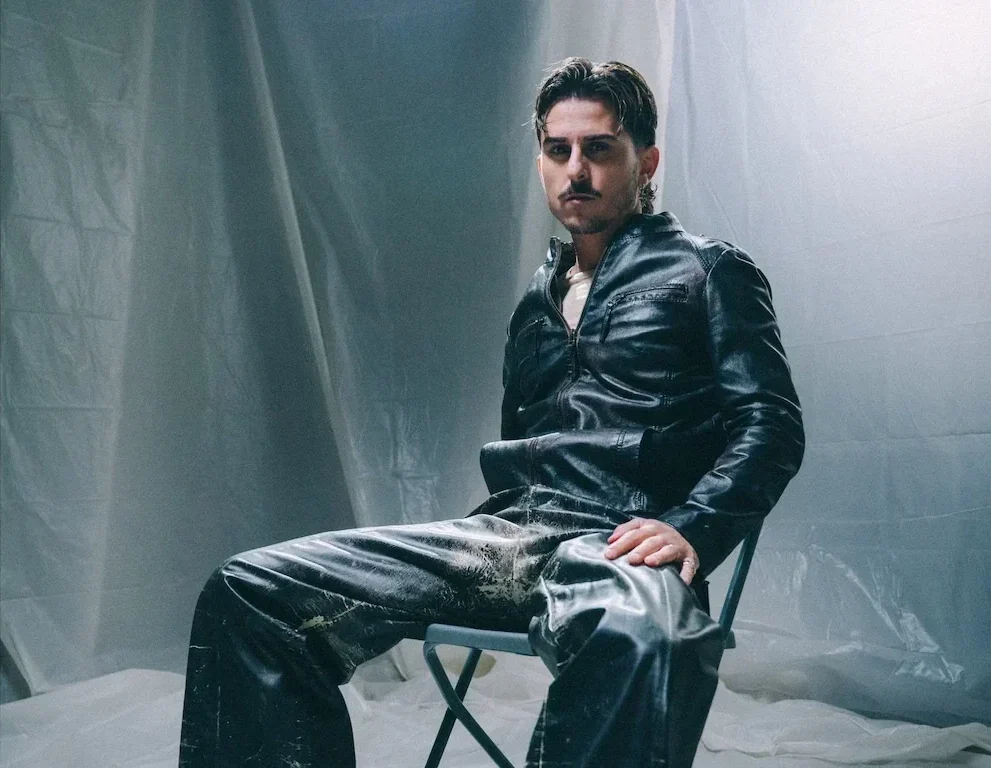
Sienna has just overcome one of the most challenging phases of her life, marked by her mother’s health, but ‘LINCE’ is the exact opposite of a melancholic album. It is an album that reminds you that “you have to live.”
Through the visceral walls of guitar, the Valencian Álex Sienna returns with a thrilling fourth album filled with anthems, stepping into the lynx’s skin to dodge all the obstacles ahead. If on ‘Trance’, his previous LP, he played with electronic textures, on ‘LINCE’ he pulls stadium rock to unleash all the rage inside. “I was very angry,” he says.
We spoke with Sienna about talking to oneself better, translating a life into songs, Barraca’s electronic scene, eternal melodies and what a convulsed period means.
‘LINCE’ is an album full of obstacles to overcome, dangers to resist, things to look after… For you, what is this album about?
Well, look, it contrasts a lot with what you just said, but I think despite that survival angle, with so many emotional states that appear in the album—the frustration, resignation, acceptance, and living through grief—I think it’s an album that speaks a lot about hope, about having that certainty that something better is coming to soothe your soul or spirit a bit. In the end I see this album like the typical screen of a video game where you pass levels and missions and reach the final. It has been worth the whole game; it’s been interesting, beautiful, and hard, but I reached the final screen. I feel it that way.
Yes, it feels like someone singing with armor on, but very worn from use.
With tough skin. It has been an album that had to be made because I needed to purge. I didn’t stop and thought that I wanted to make an album. Simply, the album happened due to the circumstances surrounding my life at that moment. It flowed that way. There was a personal drive to protect myself intelligently and not verbalize things happening in my life, because that would anchor me to them and prevent me from moving forward. The video game metaphor keeps coming back. When you’ve killed many villains, but left a few behind, you can’t face them yet because the next screen awaits and you have to advance.
And you rid yourself of them.
Of course, there are times when things are left behind and that’s it. I do believe you have to listen to yourself, know yourself… You also have to manage things, because suddenly a wave hits me in the face and it’s a shock, but there are times when you shouldn’t revel in or feed on things that have already happened. In this album they’ve remained inscribed.
Now that you’ve left all that behind, what are you taking care of yourself about nowadays?
Myself, man. Especially insomnia; I’m taking good care of that. I have trouble sleeping because I’m in a hyper-alert, even feline state. I like to control what is projected of me or my project, my career. I also try to take care not to punish myself too much for things, but I’m hopeful. I think a very beautiful phase is coming.
«A mother is always a fundamental pillar, and when you see her in a moment that hardly resembles your own mother… That moment is what explodes in this album.»
No castigating yourself too much with things… Right. I feel that we all have different problems, but at the same time we all have the same problem.
Totally, man. The human being… I think we all have that constant tendency to be very different and diverse, but we all share the same existential problems: wanting to fit in, to inhabit the skin you want to inhabit, to occupy the place you want in the world, to give yourself the value you deserve, to ignore the noise from others, and in the end you also fall. We all face the same problems, and I think the beauty is in sharing how we solve them. And that’s what makes us share, have these friendships, these bonds, or that you like an artist. I think what you like about someone isn’t what they tell, but how they tell it, because in the how, in the way you tell things, the nuance you use, the way you express yourself… All that makes something connect with you or move you.
You tell things, at least in this album, in a very epic way. In songs like ‘CEMENTO’ or ‘AFILADO’ there are many negative feelings, but the songs are luminous. They sound like anthems, and you never fall into musical melancholy.
I think there wasn’t room to be melancholic in this process. There was room only to navigate. To… I don’t like to use that word much, but to empower yourself. That’s that constant target.
From there comes the hope you mentioned earlier.
Yes, it’s what threads through the entire album and runs through it in a totally transversal way, end to end. Even in tracks like ‘VALENCIA’, which may speak more of my homeland and my roots, I think there’s a moment: let me give back everything you’ve given me. It’s like something you want to share and, in a way, position yourself at a slightly higher point of your own self.
Tell me about the collaborations with Alba Morena and La María. I would say it’s not very common for a man to have two collaborators on his album and both are women.
To me it seems perfectly normal. It’s that I listen to many women, man, and I really like the scene. From Cristina Len to Natalia Lacunza, Sara Sístole, Alba, whom I love, La María, ESTHER, who is from Valencia and is incredible… ‘VALENCIA’ I think, could not be anyone other than La María, because she has a lot of wisdom in her voice and is at that point of Valencian traditional folklore, which she is a renowned figure in Valencia. I find how she sings beautiful. And Alba, whom I admire for her career as a producer, how she composes… The strings that appear in ‘A.P.D.L.P.’ are also from her, which I love to have. And I think she has a voice with real depth. I don’t know, I think we’ve known each other for a while, I think we admire each other’s careers, there is reciprocity and nothing, we had a coffee, I presented the song and she said: ‘I’m in, Álex’. The song was already written and I gave her the freedom to add strings, to take it to her ground and do what she needed to do.
Okay, the guitars. What better way to release anger than pounding a guitar?
Plus, there are punches well landed. The guitar process has been very complex and long because they’ve gone through many stages. I co-produced them with Lagu and we recorded a ton. Then we removed a lot of wall of guitars. Then with Sean… I don’t know if you remember the band Dinero. Sean Marholm is the singer of Dinero. With him we did the final pass of guitars and sounds, because really if you remove layers and listen to it all together it sounds cool, because it’s like everything forms a wall, but if you keep removing layers there are guitars making half a joke, but if you remove them maybe everything collapses.
Guitars have always been in your career, but they left for a moment and came back, yet they remain the origin of it all.
Yes, and the treatment is very different. In this album there are some that nearly touch metal, and I say: “Damn, when did that moment happen?” I was very angry, so I needed a lot of aggression. I wanted to balance the guitars with all the electronics that were in ‘Trance’; here there isn’t as much, but the way of composing in ‘Trance’ is still very present in the album and in the melodies. I am very pro-melody. I really like arrangements that have melody, that you can sing. In some way, that is in the guitar arrangements.
How does electronic music make you feel and how does rock make you feel?
My brother runs an electronic club and spins vinyl. My brother is amazing. I’ve lived electronic music a lot at home. When we were kids, we were glued to the room. I might have class the next day and he was up until 4 a.m. banging with the wall and he was fed up. I couldn’t take it anymore. So, yes, electronic has accompanied me a lot. I remember watching him DJ at Barraca, one of the clubs on the Ruta del Bakalao. He was even a resident DJ there, in Barraca’s last moments. It was very exciting, because I felt the vibration in my chest and it was a strong outlet. Rock is more tied to my own live performance. Electronic takes me to a more ethereal point and rock takes me to a more visceral one.
In ‘Trance’, for example, did you think of your family?
In ‘Trance’ I spoke of being present. ‘Trance’ was a bit what I inhabited when I was on stage. So I needed that ethereal point I mentioned, to let yourself go. It was shedding ballast, and for me that had that electronic edge. Here I don’t want to shed ballast. I have shed it already and I simply want to say what I have to say with a very savage intention.
I know your records are inseparable from your real life.
I don’t know how to do it any other way, man. I don’t know if people will like it or not.
Do you really not know how to do it any other way?
Well, when I compose for others, yes. There I do what they tell me.
«A mother is always a fundamental pillar, and when you see her in a moment that hardly resembles your own mother… That moment is what explodes in this album.»
Have you ever thought you’re putting too much of your life into your songs?
It’s not conscious. In ‘CEMENTO’ I remember having Ableton on, I started with a beat I had, because it’s true that many of my songs are composed with guitar and voice or keyboard and voice, but that one in particular was a vomited lyric. I really started singing “I torture myself when I think you deserve this and I only find rage and never anything good” because I was living it. In my head, I wondered why my mother is suffering as she is suffering. It was torture. Sometimes you may take longer or whatever, or not find the point, but really it has been vomiting.
It’s clear that if you want to free yourself from all this you won’t make a conceptual album about something else.
I also tell you that there will be a thousand processes to reach different places, but in this case, mine has been that. Sometimes it makes me angry because… Not angry, but I sometimes feel that all the albums, or the criticisms they make, are like: it’s the most personal album of this artist. I hate that phrase. All are the most personal. I try not to mention my mother too much because I think I’ll never be able to verbalize it in a way that doesn’t anchor journalists to it. If I tell you truly what the process has been, it’s damn grim. I don’t want to fall into the banality of saying that this comes from a very convulsive personal period. What is convulsive? What does convulsive mean? Because it could be a person who has suffered depression or whatever. This has been… well, that, my parents are two fundamental pillars for me. I think a mother always is, and when you see her in a moment that hardly resembles your mother… That moment is what explodes in this album. And I’m telling you without telling you anything. Yes, it’s been a tough period, but we’ve made this album and whoever truly wants to listen and delve into the songs will do so through it.
I also think it’s about not wanting to define the album solely by your mother’s story. It isn’t about her illness.
It’s something that threads through it a lot, but it’s directed toward many places. It also talks about grit to live. ‘GARRA’ talks about having nerve to live, to inhabit your space, to do things. ‘AFILADO’ too, you know? ‘VALOR’ talks about having courage to live. Regardless of the people who may be missing, of the foundations you must hold on to, it talks about living. And that’s what I really want people to understand: that you have to live.
When did you start realizing that you have to live?
I’ve always been someone who does many things. There are days when I think maybe I should go home to rest, because that’s necessary, but I think this process amplified not stopping doing anything I want to do.
Do you think it’s more attractive someone who sings about problems or someone who only makes songs about being happy? I know this is a minority, but it exists.
It exists. And I think you can make a vital album from a everyday, real point of view. It can be done without falling into clichés. I’m not going to connect with songs that say: “How happy I am, your green eyes, how beautiful.” I connect perhaps with other things. It’s true that I connect a lot with phrases that are in perfect symbiosis with the melody. With Barry it happens a lot. He seems to place phrases into melodies very well. And that’s what’s interesting about music, man.
And it’s complicated, eh.
It is, but you have to go back to basics. Really it’s very simple, but finding the simple and making it work is tough. There are melodies that sound more expensive than others too.
Then there are others that are eternal, that are reused again and again and never go out of fashion.
And great boleros are key. I love them. The harmonic basis, the melodies… I think they’re amazing.
«We must guard ourselves from the thoughts that generate a crappy personality»
Have you ever done something you normally wouldn’t, just to try? Musically, I mean. A bolero, for example.
Yes, I have done some more funky classic on an EP I have, on a song called ‘how could you’, a bit in the vein of El Zar. I also really like what Roy Borland does, for example. I think he takes the great classics, understanding them as popular music, and I think he turns them into something filtered through his own sense of what music is.
To finish, what do you think we should take care of? In general.
We should be very careful of our own damage. Of the shitty things we say to ourselves. I think all the arguments that arise in the head are a construction. You argue with someone and replay in your head the whole argument you would have said at a moment. And inside more anger grows. A false well is created, absolutely imaginary. That well makes you have a very genuine and particular energy of that moment and that mood is produced through that energy. And a mood ends up producing a type of personality. If a person is always there, then surely if you say good morning they will tell you to go to hell. So, what you have to do is guard ourselves from those thoughts so they do not generate a crappy personality.
