
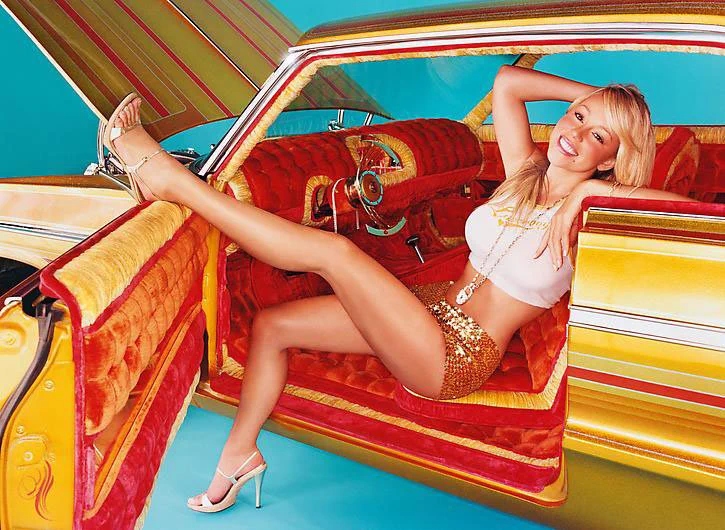
80s pop music has long served as a wellspring of inspiration for a great number of 21st‑century artists. From the era that brought us La Roux and Lady Gaga to the early years of the decade, with Daft Punk and the nu‑disco wave, the influence is clear. Mariah Carey also looked back to the eighties in 2001, but she didn’t fixate on the most obvious touchpoints: her reference was the sophisticated black pop of Cherrelle, Alexander O’Neal, or Kashif—the music she had heard at home during her childhood.
It’s worth remembering that listening to 80s music in 2001 wasn’t exactly the same as reviving today the Y2K pop of 2002, 2003 or 2006. Back then those songs still circulated on the radio and didn’t feel as remote as they might seem now. The idea behind Glitter carried, therefore, a certain risk: Mariah wanted the 80s black pop to sound current again, blending it with the codes of R&B and pop of her own era.
The result is, perhaps owing to its status as a soundtrack, a little patchwork of ideas. Some tracks work very well, such as the ballad “Never Too Far”; others fall short, like the single “Loverboy,” and some don’t fully land, especially the remakes. Yet the album preserves its charm as a pop work with considerable personality, especially when compared to the film it was created for.
“Glitter” was a commercial and artistic failure in its film incarnation. Today it seems only salvageable in a kitschy sense. The film tries to tell too many things at once—fame, the search for family, and romance—but ends up not exploring any of them in depth. The script is superficial and predictable, and Mariah herself doesn’t display strong acting skills. Although she is the star, her co‑star Max Beesley ends up bearing a large portion of the dramatic weight.
The album, reissued now for its 25th anniversary, endures the test of time better than one might expect, although not all of its ideas land equally well. The uptempo productions are catchy and sonically attractive, but the contrast between Mariah’s airy, front‑and‑center voice and the backing tracks sometimes sounds forced. On disco‑funky tracks such as “Loverboy,” “I Didn’t Mean to Turn You On” (a Cherrelle cover) or “All My Life,” Mariah’s voice, open and prominent, tends to eclipse the groove. The songs can sound a touch overbearing, something that doesn’t happen when this sound is later picked up by Bruno Mars, Doja Cat, or Fabiana Palladino.
Strangely enough, the ballads—rather than the disco and funk excursions, though those are defensible and central to the concept—fit best, notably “Never Too Far” (with those impressive vocal runs) and “Lead the Way.” Both tracks sport productions that feel overly polished, far from the elegance Mariah would show in later moments of the 21st century, yet they allow a clearer appreciation of her vocal prowess. The breezy “If We” also stands out, the song that most clearly connects with the contemporary R&B of the era.
The album features a handful of guests: rappers Ludacris, Da Brat, Shawnna and Twenty II appear on the remix of “Loverboy,” released to promote the film, whose video gave us a divine Mariah wearing a top made from a scarf; Busta Rhymes participates in the Indeep track “Last Night a DJ Saved My Life,” and Mystikal appears—with a shouted contribution that’s fairly polarizing—in the odd “Don’t Stop (Funky 4 Jamaica).” “Twister” is probably the most singular ballad in the repertoire, with a lullaby‑like sound. It’s dedicated to a friend of Mariah who took her own life the previous year.
The reissue includes a second disc with material more interesting than it might seem. In addition to the superior original version of “Loverboy,” which sampled Yellow Magic Orchestra’s “Firecracker” before the song was rebuilt around Cameo’s “Candy,” we find the medley of “Never Too Far” and “Hero,” recorded after the 9/11 attacks. The merging of these two songs turned Glitter’s most personal track into a message of national solace. It was also one of Mariah’s first steps back toward public activity after her hospitalization.
Among demos and remixes of uneven interest stand out Channel Tres’ take on “All My Life,” leaning toward house, and Rochelle Jordan’s version of “I Didn’t Mean to Turn You On,” with a sharper, more fractured sound that sits between electronic R&B and garage. But the loveliest part of the reissue is that it closes with the 2018 Glitter medley. It’s a symbolic gesture for what Glitter represents in Mariah’s career: finally reconciled with one of the darkest periods of her life, she can reclaim her songs after decades of jokes at her expense.
The Glitter era deserves recognition, at least for being one of the most ambitious projects Mariah has undertaken. And this is so despite the film’s questionable result and the fact that it arrived during one of the worst moments of her life: changing labels, the breakup with Luis Miguel, the controversy over the Loverboy sample, and hospitalization for physical and emotional exhaustion. During those months, the press spoke of “erratic” behaviors and mental collapses—coverage that tends to fixate on women in particular.
In a 2002 interview, the 32‑year‑old singer recalled that perhaps what she needed, for once, was to sleep a full night without being woken up by a call about “a video.” Since her debut in 1990 she had never stopped working, and at that time she could go for days without sleep. Today we’ve normalized that work shouldn’t invade rest time, but perhaps Mariah felt she had too much to lose if she stopped pushing herself to the limit, especially in a fiercely competitive pop world. She ended up hospitalized, and Glitter collapsed like a punctured balloon, just as the United States was sinking into a collective mourning period.
Time has allowed us to hear “Never Too Far” differently: first as a personal song and later as a message of solace for an entire country, without its vocal acrobatics needing to astonish at any moment over these 25 years. In Spain, by the way, the album’s reception was different: it debuted at number 3 on the sales chart and earned a Gold Disc for selling at least 50,000 copies. The Glitter megaflop narrative tends to be built, understandably, from the American perspective.
Today, that era reads as a double time capsule: a 2001 album that looked back toward the 80s and a portrait of a particularly defining moment in Mariah’s career. Twenty‑five years on, we can admire it with all its glitter, but with far less noise surrounding it.
