
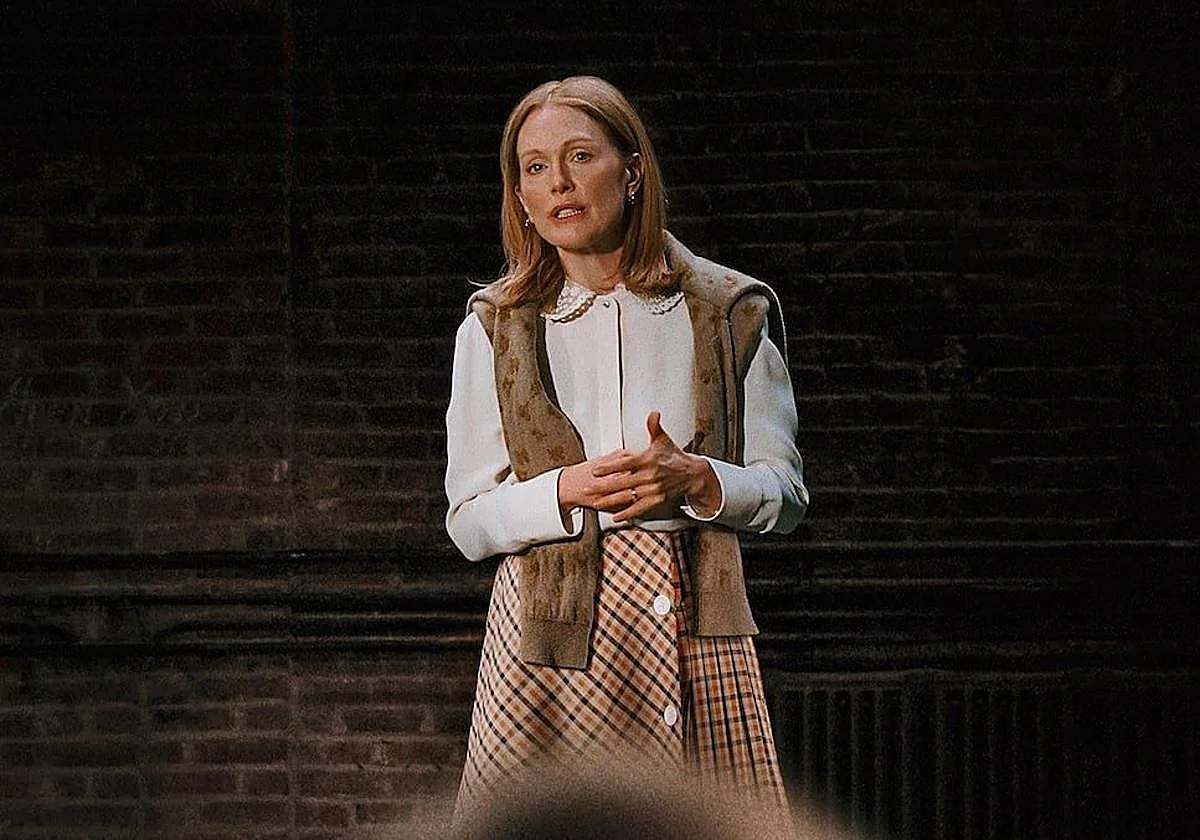
With the memory of the late José Luis Cienfuegos, the director who revolutionized the festival in the nineties until turning it into a benchmark of independent cinema—the “European Sundance,” as it came to be known at the beginning of the century—kicked off the 64th edition of the Gijón/Xixón International Film Festival (FICX).
Ten days of cinema and encounters with filmmakers such as Peter Mullan, Carlos Reygadas or, as if paying homage to Cienfuegos’s legacy, Hal Hartley, one of the emblematic names of that era, whom the festival dedicated a retrospective to in 2003. Below we review 10 (+1) of the most notable films of this edition (we do not include the already reviewed “Adolescence, Sex and Death at Camp Miasma”).
‘The Debut’: Julianne Moore (en)chanting toward the Oscar
It has been one of the festival’s most celebrated films. Sold-out tickets, applause during the screening and a thunderous final ovation. At times it felt like we were in Sitges and not in a northern city. The truth is that such enthusiasm is more than justified. ‘The Debut’ marks the confirmation of Jesse Eisenberg’s talent as a filmmaker, following the promising ‘When You Finish Saving the World’ (2022) and ‘A Real Pain’ (2024).
With a stellar Julianne Moore starring (poised to claim her second Oscar), ‘The Debut’ is a well-crafted blend of a fable about female emancipation in maturity, a satire of egos and vanities in the acting world, and a homage to neighborhood theatre. The story of a shy housewife who discovers her artistic vocation by taking part in a modest musical provides Eisenberg with material to build a hilariously entertaining comedy, packed with ulterior motives and reflections on the roles we all play in life. 8.3.
‘Fatherland’: journey through the ashes of Germany
The paths of Pawel Pawlikowski (‘Ida’, ‘Cold War’) and the Javís have continued to cross since they shared the Best Director prize at the recent Cannes festival. ‘Fatherland’ and ‘The Black Ball’ have again led the nominations for the European Film Awards, with eleven and ten nominations respectively. Will they repeat at the Oscars?
The new film from the Polish director explores the wounds of a divided Germany through the journey undertaken in 1949 by Thomas Mann and his daughter Erika (fabulous Sandra Hüller). After 16 years in exile, the Nobel laureate returns to his homeland to receive several tributes, in a journey that will take them from the American-occupied zone to the Soviet-controlled area. A journey through a country devastated both materially and morally, where ruins coexist with the ghosts of Nazism and the tensions of the Cold War. But also an intimate journey, marked by the wounds and conflicts of the Mann family itself. A distillate and highly concentrated film, somewhat cold in its execution, that manages to condense in barely 80 minutes the weight of a historic and familial tragedy. 7.8.
‘The Guest’: arriving and winning the festival
The prize for Best Feature at FICX has gone to one of the year’s strongest European debuts. ‘The Guest’ is nominated for the European Discovery Award at the European Film Awards, the category that recognizes new talents in continental cinema and honors the best debut of the year. Mads Mengel places himself in the tradition of Scandinavian family drama (explicit reference to playwright August Strindberg), with touchstones such as ‘Celebration’ (1998) or ‘Queen of Hearts’ (2019), but emphasizing a tone of uncomfortable comedy closer to Ruben Östlund’s cinema.
Much of the film’s dramatic effectiveness is owed to Trine Dyrholm, “the guest” of the title, who crafts a character as irritating as moving: an unpredictable, invasive, emotionally fragile mother, capable of oscillating from tenderness to chaos in seconds. Her sudden intrusion into a family celebration triggers a sequence of increasingly awkward situations, exposing old resentments and unresolved conflicts. Dyrholm makes it impossible for us to decide whether to laugh at her character, pity her, hate her, or all of the above. 7.9.
‘Everybody Wants Bill Evans’: play it again, Billy
Grant Gee has leaped into fiction with a bang. With a long career directing music videos for artists like Radiohead, Blur, or Nick Cave, and music documentaries such as ‘Joy Division’ (2007), the British filmmaker won the Best Director prize at the last Berlin Film Festival, and his film, which will be released in Spain on November 27, has also received several nominations for the British Independent Film Awards.
An adaptation of the novel ‘Interval’ by Owen Martell (published in Spain by Entre Ambos), ‘Everybody Wants Bill Evans’ is a kind of (anti)biopic about the jazz pianist Bill Evans. Through a fragmented narrative that alternates different timelines (the main story is set in 1961) and reconstructs the musician’s childhood from his relationship with his parents and his brother, Gee builds a portrait of a man marked by death (of friends and family), heroin addiction, and a silent self-destructive impulse. The editing, with a nearly jazz-like rhythm, combines ellipses, time jumps, and visual associations that manage to convey the protagonist’s mood extraordinarily well. 7.7.
‘Paper Tiger’: Adam Driver and Scarlett Johansson, from marriage to the mafia
As in last year’s edition, with the fabulous ‘Blue Moon’, this year’s FICX could not have started better. The opening film was ‘Paper Tiger’, James Gray’s return to mafia cinema and family dramas from his origins, those of ‘Little Odessa’ (1994), ‘The Yards’ (2000) or ‘The Night Is Ours’ (2007), though in a different register. It also marks the reunion of Adam Driver and Scarlett Johansson, seven years after their spectacular acting duel in ‘Marriage Story’ (2019).
Set in Queens, in 1986, ‘Paper Tiger’ (a title that alludes to the expression “paper tiger”) is an intense family drama interwoven with a powerful criminal plot. The story of two brothers who embark on a venture that ends up pulling them into the Russian mafia serves Gray to craft a blend of thriller and melodrama where economic ambitions, family loyalties, and personal secrets intertwine to culminate in an unpredictable spiral of consequences. Classic storytelling, elegant composition, superbly drawn characters, and two final sequences that are best left unrevealed but which rank among the director of the extraordinary ‘Two Lovers’ (2008). 8.4.
‘Coward’: queer romance in the trenches
Chance had it that, in last year’s Cannes official section, two films addressed wartime conflicts from a queer perspective: ‘The Black Ball’ and ‘Coward’. Interestingly, both were awarded: the Javís shared the Best Director prize with Pawlikowski, while the leads of ‘Coward’, Emmanuel Macchia and Valentin Campagne, jointly received the Best Actor award.
The highly anticipated new film by Lukas Dhont, following acclaimed ‘Girl’ (2018) and ‘Close’ (2022), is an anti-war manifesto that moves the concerns of the filmmaker—masculinity construction, the suppression of desire, and the difficulty of expressing feelings—into the trenches of World War I. The love story between two young soldiers, one of whom is responsible for organizing musical performances and drag shows for the troops, allows Dhont to juxtapose the brutality of war with the tenderness and freedom the characters find onstage and behind the scenes. A singular blend of war drama, queer melodrama, and musical, perhaps a tad lengthy and predictable, but with great sensitivity and visual beauty. 6.9.
‘The Only Living Pickpocket in New York’: bad streets, new times
One of the festival’s great surprises. Who would have thought that a performer with such a discreet track record as Noah Segan (a regular supporting player in Rian Johnson’s films), who debuted as a director with a modest horror-comedy like ‘Blood Relatives’ (2022), would sign a film as elegant, mature, and moving as ‘The Only Living Pickpocket in New York’?
An extraordinary John Turturro, who looks strong for his first Oscar nomination (surprisingly, he has never been nominated), plays the “last pickpocket in New York,” an old thief in the era of digital payments who, after stealing something far more valuable than money, ends up entangled in a dangerous criminal plot. From this premise, Segan builds a splendid twilight-thriller that recovers the spirit of 1970s New York crime cinema, with echoes of Lumet and Scorsese, but also a poignant homage to a city and a way of life fading away. A tribute to the old cinema of losers, as melancholic as it is vibrant. 8.5.
I See Buildings Fall Like Lightning: When Dreams Collapse
Clio Barnard (‘The Selfish Giant’, ‘Ali and Ava’) is one of the standout voices of contemporary British social realism, heir to the Ken Loach and Mike Leigh tradition and close to the sensibility of Andrea Arnold. ‘I See Buildings Fall Like Lightning’ particularly recalls Andrea Arnold’s cinema for its overwhelming narrative energy, its naturalism, and the importance of songs, which lend the story an almost euphoric rhythm.
The film follows five friends from a working-class Birmingham neighborhood who, as they reach adulthood, discover how social differences, precarity, and thwarted expectations threaten to fracture their bonds. Barnard blends the rawness of social portrait with contagious vitality, supported by a superb soundtrack, with The Streets (Mike Skinner grew up in Birmingham) taking a prominent role, alternating the euphoria of party nights with the melancholy of dreams that fade. An ensemble drama, sweeping in its first part but somewhat forced dramaturgically in the second, that speaks to the difficulty of maintaining friendships as life begins to pull paths apart. 7.
‘Moulin’: the Martyr of the Resistance
László Nemes seems to be unable to escape the feeling that with his debut he achieved what takes other great filmmakers a lifetime: to sign a masterpiece, win at Cannes, and sweep the Oscars, BAFTAs, Golden Globes… ‘Son of Saul’ (2015) set the bar so high that any subsequent film seems doomed to live in its shadow. This happened with ‘Sunset’ (2018) and ‘Orphan’ (2025). And it has happened again with his new work, which was met with tepid reception in Cannes.
‘Moulin’ is not a masterpiece, but it is a notable biopic. The film reconstructs, through an absorbing narrative and superb production design, the final days of the French Resistance hero Jean Moulin, captured and tortured in 1943 by the Gestapo chief in Lyon, Klaus Barbie, the “butcher of Lyon.” The Hungarian director again immerses us in the horrors of World War II through a tense espionage thriller that finds its best moments in the physical and psychological confrontation between the resistor and his tormentor. Will Nemes win back critical favour with his next project, an adaptation of Cormac McCarthy’s ‘The Outer Darkness,’ starring Jacob Elordi and Lily-Rose Depp? 7.5.
‘No Place to Look / The Day She Returned: The Art of Repetition
And finally, a festival classic. Since 2013, when a retrospective dedicated to Hong Sang-soo was organized, previously unseen on Spanish posters, a large part of the prolific Korean filmmaker’s filmography (35 feature-length films in 30 years) has been shown in Gijón.
His two latest films follow the path of his recent works: increasingly smaller productions, stripped of any artifice, with a minimalist staging and built from long conversations that seem trivial, chance encounters, and variations of everyday situations that hide unexpected emotional depth. A cinema reduced to its minimal expression, in which Hong handles almost everything: writes, directs, produces, shoots, edits, records sound, and even composes the music.
‘No Place to Look’ is a melancholic comedy about family relationships and artistic creation. It tells the journey of an experimental filmmaker (Kim Min-hee, partner and muse of the director) to Jeju Island with her brother to reconnect with their mother. Between awkward conversations, small disagreements, and moments of complicity, Hong explores the difficulties of communication between parents and children and the different ways of understanding art and life.
‘The Day She Returned’, for its part, offers an ingenious and extremely austere metacinematic game based on a very simple premise: an actress who returns to the profession after years away gives three promotional interviews in which she answers very similar questions, albeit with small variations. The conversations she then attempts to reconstruct during an acting class. Three settings, four long takes, and a static camera with a small zoom are enough for Hong to reflect, through words, on art, the passage of time, and the blurred boundary between sincerity and representation. 8.
