
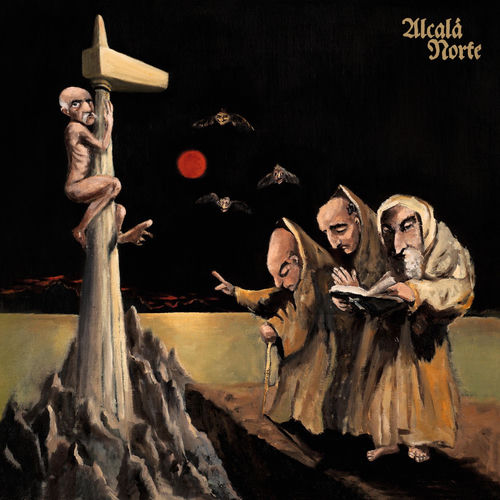
The second album from Alcalá Norte had to be taken in stride, because the history of music journalism is full of colossal missteps when it comes to judging sophomore records. I still remember when Q magazine awarded Oasis’s second disc three stars: “they fill a gap and that’s about it, they don’t say much about anything.” The very Rolling Stone, in 1991, had given the same stingy rating to Nevermind: “Nirvana doesn’t bring anything totally new.”
Leaving aside the possibility that both criticisms could have a point—that neither album was as musically ambitious as OK Computer—the truth is that both records ended up becoming generational statements. There are 3.5 stars. And there are 4.
What first comes to mind when listening to “Dejémoslo como estaba” (Let’s Leave It as It Was), with a title that already does it few favors, is that it lacks tracks as immediate as those on their debut. That some songs merge with others, just as didn’t happen on the group from Madrid’s first record, where every track oozed a commanding personality.
What is clear from the start, however, is how much Alcalá Norte have grown musically with the co-production of guitarist Carlos Elías. In interviews the band members themselves laugh as they describe the deep differences in their tastes—from heavy metal to post-punk to new wave—and on this album they manage to make that amalgam sound fully integrated, turning the odd into a virtue. The first thing you hear is Laura de Diego’s keyboard, as if drawn from a jevi ballad, which later gives way to the neo-romantic on “Campos de golf” or definitively enhances the metal influence in the French 1980s cover by the group Icare. All the while the post-punk guitars don’t stop elevating “El Endemoniao.” All the while they don’t stop sounding like Alcalá Norte, only now with a hint of gothic rock.
Every single tracks grows dramatically once placed in the running order, but in this group the lyrics are what take things to another level. Put simply, no one writes like Álvaro Rivas, or the way he writes. If the phrase “La vida cañón” had come from a 1930s newspaper clipping about the Christmas lottery, “Let’s Leave It as It Was” dives deeper into that astonishing documentary work, utterly overwhelming. If there were a Christmas box set, it would necessarily include books by Nietzsche, Zweig, Goethe, Heidegger, Jünger, and other authors you may not have heard of.
The album begins in the theater of the Battle of Valmy, where Goethe accompanied Prussia and concluded: “on this day a new era of world history begins.” By juxtaposing the journey “through the gates of death” with the chant “fuck, I feel indifferent,” it references Nietzsche, and the nihilism he applies to our times appears in “El Endemoniao” (“I don’t believe in God”) and, above all, in the track that yearns for evil called “Campos de golf,” through the metaphor of parks that run dry.
The class struggle is the protagonist in “Claudia,” who is none other than the household helper we pay 50 euros to clean, and in this track a hint of genocide will resurface in “El contador de muertes.” “Will this be the slaughter of my era? (…) Let’s see if the SAMUR doesn’t arrive,” intones Rivas, rarely speaking of himself, and rarely losing his sense of humor.
“Los llamados pitagóricos” takes its name from an ironic line of Aristotle, for considering that “the principles of mathematics were the principles of all beings.” In Alcalá Norte’s underground milieu, the song manages to sound both self-affirming and playful, just as “El hombre planeta” does in its humorous dialogue about the Paganini myth recounted by Heine:
— And who are you, dog?
— I am your manager, Satan. Who else will help you?
— I will not degrade, you bastard, my soul. I will not regain my calm just to earn a million
Added to this is a track about their admired Arturo Soria, who was also “pitagórico,” and about his project to unite Madrid, making it unsurprising that the band defends—with pride and conviction, not only with their usual irony—that this album is better than the first. Here the only blemishes are the multilingual demonstrations. The French version sits well, but the English song—dedicated to a DJ they know who lives in Berlin, rendered somewhat poorly with Shakespearean language—takes the humor too far and perhaps not through the most fortunate channels. It sounds so rudimentary that it could even trigger a split if it hadn’t come from Rivas’s own head, against all odds.
It is, in any case, the work of a singular, elevated and privileged mind that prefers talking about Heidegger to Pitchfork or Fantano, offering a journey through the last 2,500 years of civilization, something very different from what we’re used to. Alcalá Norte are so impressive that you might soon see me singing at a show the line “T H E T I N Y O N E.”
