
MIRA once again turns the Montjuïc Fairgrounds into a territory of audiovisual exploration. In its 15th edition, the Barcelona festival continues to bet on a format where concerts are only part of the experience. Installations, projections, and digital interventions form a parallel journey that invites visitors to discover the venue beyond its stages. This year, several installations play precisely with that boundary between the human and the artificial, from the digital ecosystems of Sarabiotic to the luminous figures of ‘Humans’, which react to the movement of those approaching them. Between one performance and another, the audience discovers these proposals.
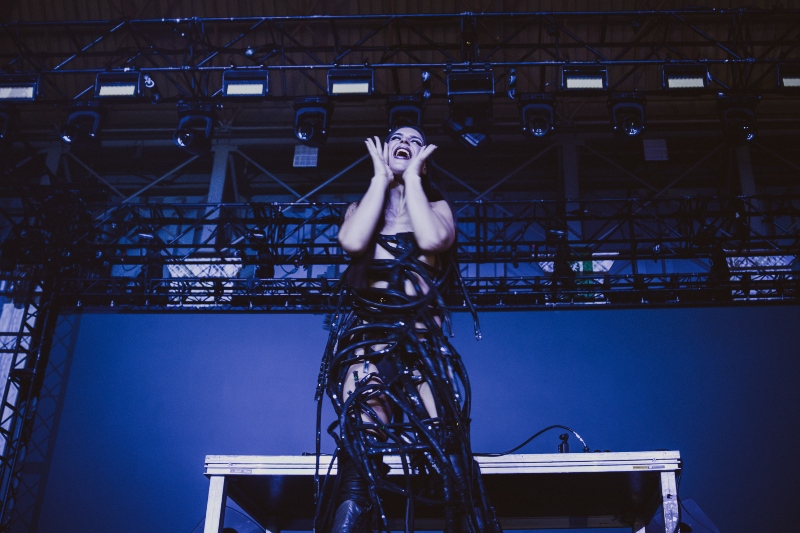
Arca offers one of the most fascinating performances on Friday, as the festival returns to Barcelona with sold-out passes. The Venezuelan artist DJs dressed in black cables, in an image that, I’m told, recalls ‘Ghost in the Shell’. I see the figure from her album XXXXX coming to life. But that is not the material she presents this Friday at the Barcelona festival.
Her set begins with abstract techno, impossible to grasp at first glance, but gradually she incorporates traditional Latin rhythms and accelerated percussion rooted in Africa, culminating in a genuine explosion of fun and frenzy. Her approach to music is—lacking a better term—holistic: Arca seems to find techno within those ancestral rhythms, as if they all shared a single physical and collective function. She doesn’t need to establish hierarchies between experimental electronic music and popular music nor turn one into exotic references for the other. Everything is part of an absolute musical continuum, a nearly pre-genre conception of music in which labels cease to matter. It is amusing to see her urge the audience to dance to rhythms seemingly impossible while shouting into the microphone, flinging herself onto tables, and asking for a glass of champagne. Until, suddenly, it turns out, yes, you can dance. And it’s impossible to stop.
A little earlier (actually Arca came after), Fennesz, accompanied by Lillevan on visuals, celebrates the 25th anniversary of Endless Summer, one of the landmark records of early-21st-century experimental electronic music. Published in 2001, the album redefined the possibilities of glitch by combining processed guitar recordings, digital noise, and melodies of luminous beauty, shaping a kind of summer remembered through a deteriorated memory.
The performance allows savoring that balance between abstraction and emotion that few artists have managed to capture so accessibly. The orange visuals, with a sci-fi and hypnotic aura, aren’t particularly sophisticated, but they suit the experience well. Fennesz works with an electric guitar connected to a computer, where he processes and transforms his sound through software, samplers, loops, and real-time effects. At his side, Lillevan manipulates the visuals, in an audiovisual collaboration that functions as a dialogue between two instruments. A technical glitch forces a brief pause, but the calm of ambient, noise, and processed melody ultimately envelops the audience.

Shygirl, known especially for her club-pop persona, arrives at MIRA with a new album released yesterday and a guitar-driven reinvention that may convince some more than others, but she delivers it with conviction. Facing a sizeable crowd, to the point that dancing freely ceases to be optional, she presents a show more in line with guitar-based indie than the electronic party many probably expected.
Her ethereal melodies live alongside visuals from the Barcelona studio Onionlab and a sonic palette that moves between indie, pop-rock, and club. The electronic onslaught comes mainly toward the end, when she recaptures part of the club energy that originally brought her into the spotlight. There remains the feeling that part of the audience had come precisely to chase those hits, and now one must digest that Shygirl offers… something else.
Tortoise demonstrate their craft with a performance that crosses their own territory between post-rock, jazz, and slowcore, featuring patient instrumental developments and their usual precision. More uneven is the live rendering of Rumspringa, the excellent album by ear that revives the spirit of glitch-pop from the 2000s.
The American duo are full of songs, creativity, and stage presence, perched halfway between emo and shy, but the excessive volume of sound does them no favors. Their domestic pop does not quite translate well to a stage of this size, and some bass lines become hard to handle from the front rows. A pity, because behind that wall of bass and reverb there is one of the season’s freshest records. In the end, MIRA ends up drawing a sonic continuum in which all genres, eras, and traditions seem connected, like different expressions of the same music.
