
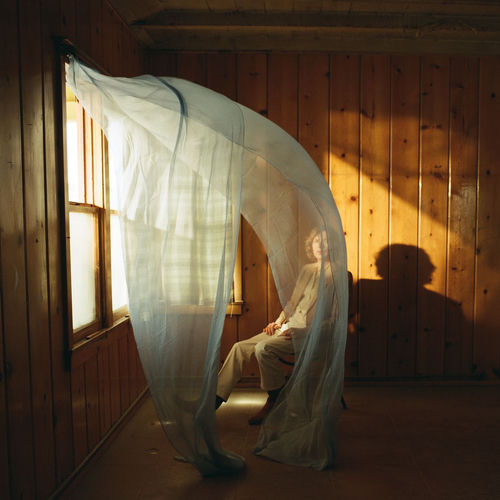
‘Ride Lonesome’: the album title by Beck conjures the image of a solitary rider crossing the desert, his cowboy hat casting a shadow over a worn, downturned face. Yet this man is no hero in disguise; he isn’t chasing justice or staging some grand showdown. He simply rides his troubled horse, heart broken, tattered to the core.
Beck seeks to “find the way through tears” on Ride Lonesome. He looks for “answers to what he already knows” on Run Away. He dodges “madness that leaves him gasping for air,” pleading for someone to “give him back his life” on Failed Words. He doesn’t quite know “where he’s headed, though he’s already wandered there before” on Bleed. And so it unfolds, twelve tracks deep, with a single-minded, almost monothematic thread.
Beck Hansen’s own state of mind sinks to a nadir in It Ends Right Here, where the lyric declares, “the temple I built in your room / crowns of your glory; no one can take it, and no one ever will.” Fortunately, the notion of acceptance surfaces later, in the midst of the night—an undercurrent that recurs across the album, not just in the single In the Night. Because light is the decisive word in the closing track, where “the river washes away the sorrows.”
Musically, the record also bleeds into other moods. There are moments that feel stark and exposed, as on For Your Love—a remarkable piece built without guitars or drums, featuring a couple of trumpets and, above all, a cohort of stringed instruments, highlighted by as many as eleven credited violinists. It calls to mind the grand, ostentatious flourishes of Nick Drake, while remaining a rare production that could have been penned by Björk in her Homogenic era. Yet as the album moves toward its end, a sense of calm gradually takes hold through the melodies and the quiet, yielding to Beyond the Light. One could imagine an album that finishes with the last glimmer of hope extinguished for the heartbroken.
Ride Lonesome is, in broad terms, an album that drags its feet through American textures and desert air, much like Sea Change and Morning Phase, with which it could form a loose trilogy by reuniting old friends like Justin Meldal-Johnsen and Joey Waronker. Still, it gradually widens its sonic horizons.
In truth, Beck’s folk exploration truly began to take shape with Mutations, a largely acoustic record even as it wore the tropical guise of Tropicalia. That sprawling 1998 release also introduced Nigel Godrich, the producer of OK Computer, whose presence here—clearly felt even if primarily as an engineer on Falling Through My Hands—hints at a deeper, more refined craft. In this regard, the arrangements—flutes, harmonicas, the oboe and clarinet, and Beck’s own versatile synthesizer—carry the project beyond any dour, linear trap. It is not, by any stretch, morose.
The album’s heart remains intact. The chorus of the lead single Ride Lonesome and the centerpiece In the Night are given new life by other tracks that surpass them in both structure and production ideas. Some listeners will always prefer the Beck who fused blues, rap, electronics, world music, and countless other influences within a single album—the Beck of Odelay. And yet this new collection holds its own, and it is beautiful in its own right.
