
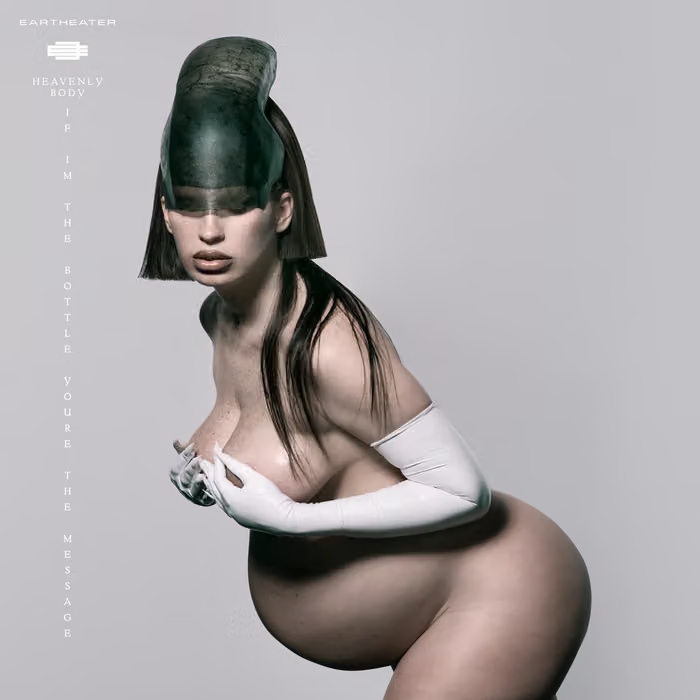
Many records have emerged from the experience of motherhood, ranging from the most mainstream pop (Ray of Light) to the more experimental (Medúlla). Some artists, like Laura Marling, even preemptively wrote an album for an imaginary daughter (“Song for Our Daughter”) before actually having one. In Spain, Rigoberta Bandini has also touched the theme from time to time. But few albums have devoted themselves entirely to this experience as completely as the new work by Eartheater, and even fewer from such a singular perspective.
The sixth album by the American artist of Russian and British heritage, whom we came to know through works like “Phoenix” and a truly astonishing vocal range, is an album about motherhood in all its aspects: the most beautiful and poetic to the most raw. Written during the postpartum period, it conveys a striking clarity about Alexandra Drewchin’s new physical and vital reality.
Eartheater writes about the corporeality of motherhood, but also about its more esoteric dimension. Thus the album moves from evoking the “Kaisoona moon” in the mystic “Wasp in the Fig” to images as blunt as those in “Hers Before Hers,” which speaks of the inherited gestational body, but also of the violence of conceiving, when the unborn child is still faceless and only a “pee-stained stick,” or when “the baby is too big for my cervix.” Alexandra comes to write that her body “is about to burst,” as if her own skin has begun to tear to make way for a new life.
Much more accessible than her early works, the record leaves behind folk to embrace a serene electronic pop that flirts with trip-hop, ambient and, occasionally, electro or synth-pop, always at the service of Eartheater’s beautiful voice. All is wrapped in cinematic-sounding strings that lift songs such as the chilling single “Paradise Rains,” which speaks of a paradise “where there was once a hell”; the surprisingly eighties-influenced “Don’t Look Back”; or the opening “Molka Momma,” an adaptation of a traditional Bulgarian song.
This more song-centered approach greatly enhances the storytelling. The bucolic trip-hop of “Practical Amnesia” offers a precious portrait of childbirth, juxtaposing pain and memory: “It was like ten million wasp stings around my thong… but in my memory, it was the kiss of the butterfly’s wing.” In a similar register, “Crown Jewel” shines with the double meaning of “stand tall like Grace Jones,” a line that alludes both to the height her daughter will reach (“stand tall”) and to the need to preserve dignity.
When, in the noir electronic track “Favorite,” she sings about the “masochism of motherhood” and turns to almost divine imagery such as “when you came out of me, I lost my freedom; serving you is serving God; I can no longer escape love,” it becomes evident that Eartheater is a uniquely gifted composer. Her imagery blends literalness with a deeply poetic naturalism, and her connection to the sacred makes these songs intensely personal, never shying away from the bodily violence of pregnancy and birth.
Her way of composing is also strikingly original, though that is something we already knew. Here, even pieces as abstract as “Glowing Guts,” a spoken-word piece over a cello accompaniment that sometimes feels like a freestyle, work thanks to the unmistakable character of her lyrics: Drewchin speaks of being pregnant while making playlists, of fucking on the side, or DJing alongside Boys Noize. “Fast Asleep,” her collaboration with Oklou, doesn’t function as a conventional duo but as two parallel voices recounting different experiences of the same transformation. It isn’t by chance: Oklou became a mother almost at the same time as Alexandra, and the two ended up sharing a nanny.
Nova, Eartheater’s daughter, gives the title to the closing ballad, which we’ve known about since June of last year. Produced with Nosaj Thing, the song rests on a haunting ambient keyboard melody and a voice treated with Auto-Tune to bring motherhood closer to a nearly mystical experience: “Nova cherub, fractal springing from ambrosia, born from chaos, so perfect from the heights.” Even its most intangible images feel immediate in an album that reshapes motherhood into mythology.
