
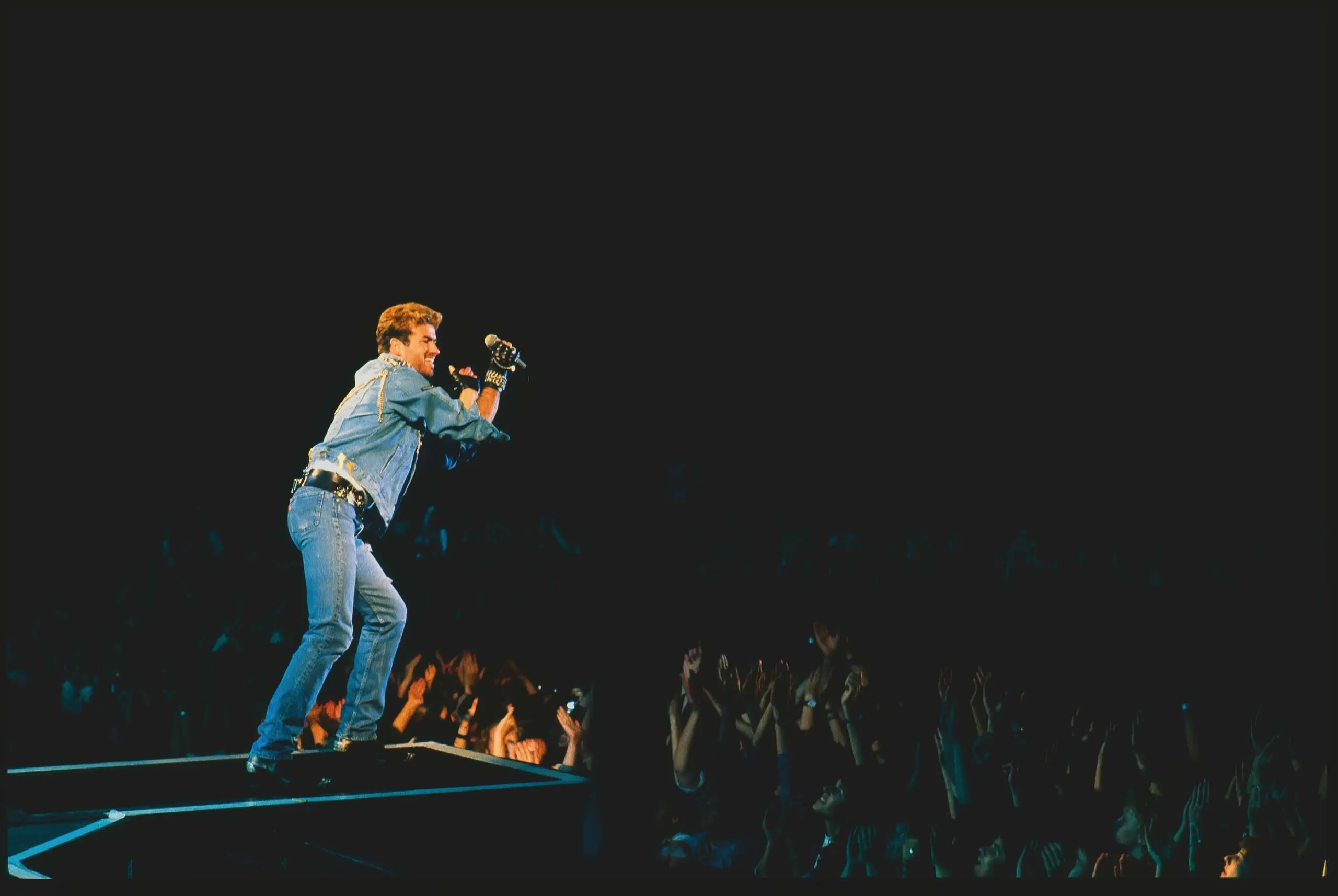
With “Faith,” his first solo album in 1987, the Wham! singer conquers the world. But behind the leather jacket, smoky sunglasses and sexy poses hides a man plagued by doubt, trapped by an image he himself crafted. A tale of a triumph as spectacular as it is paradoxical.
30 October 1987: in stores lands Faith, George Michael’s first solo album, a project he poured more than a year of tireless work into—switching studios, redoing takes, exhausting the musicians, delaying the release because a dancing track was missing, inspecting every detail down to the typeface on the cover, directing each of the music videos himself. The album of diamond records: more than 25 million copies sold, four singles topping the Billboard Hot 100, a first Grammy Award, three American Music Awards, a harvest of international honors. And, forty years later, a billion streams on Spotify.
Ranked among the greatest albums of all time and considered “sometimes too good” by Rolling Stone, Faith marks the metamorphosis of one of the 20th century’s biggest artists. Or, how a singer who emerged from a teenage boy band would establish himself as a major star while facing his own demons. A year earlier, at Wembley Stadium, Wham! gave its farewell concert. The split had been announced for months: George Michael announced his desire for independence and his plan to fly on his own. He had already recorded Careless Whisper, written years earlier in his teenager’s bedroom, and I Knew You Were Waiting (for Me), a duet with Aretha Franklin, the greatest voice of soul in his view. Yet he confronted a major problem. Despite churning out hits in abundance—Club Tropicana, Everything She Wants, Wake Me Up Before You Go-Go, or Last Christmas—the phenomenal success of Wham! had become a trap. Critics reduced him to a mere poseur, “sex and shorts”, according to Roland Orzabal of Tears for Fears.
Others only fixated on his supposed homosexuality, which he denied, or on alleged drug use, which he contested. “The press portrayed me as a silly, gossipy kid. Wherever I went, I had to prove I wasn’t stupid. It took courage at the time to play the clean-cut, prissy guy. We did it for laughs, but people didn’t laugh. This image damaged my musical credibility,” he recalled at the time.
The Beginning of the Ascent
It is with Faith, a true identity-conquering album, that the rest of the world finally begins to look beyond the fluorescent shorts. Recording began in August 1986 at SARM West studios in London. George Michael reunites with Chris Porter, his sound engineer and ally since the early Wham! days. He intends to take control from start to finish: composition, arrangements, production, vocal takes.
A perfectionist to the point of obsession, George isn’t a virtuoso instrumentalist, but he possesses a phenomenal instinct. He knows precisely what he wants to hear, dictates chords to his musicians, requests a note be redone until it achieves the right color, or lets them work alone for days, waiting to find the missing melody.
A Matter of Transformation
Thus emerge One More Try, a heartbreaking ballad written in a matter of hours after George heard a pianist perform songs by the Spinners. Kissing a Fool reunites him with his passion for jazz. Hard Day leans toward Prince, while Faith, with its guitar riff borrowed from an old six-string left by the Damned and its organ introduction, makes a pointed nod to Wham!’s Freedom. And then there is the indispensable I Want Your Sex, a sultry track built on a LinnDrum glitch that delivers a hypnotic pulse and a proto-acid house feel ahead of its time.
With I Want Your Sex, George Michael challenges moralistic discourses on sexuality, at a time when the AIDS crisis fueled widespread anxiety. The track ignites an international controversy. Radio stations refuse to play it, or replace the word sex with a beep or with the word “love” in some cases. The video faces multiple cuts before MTV agrees to air it. But the ensuing bad buzz cements the new image of George Michael: an adult, provocative artist who speaks about sexuality without hesitation. Another sign of this transformation: his new look, borrowed from Elvis Presley—tight jeans, three-day beard, leather jacket, carefully brushed hair, white T-shirt, and smoky aviator sunglasses: the former chubby, bespectacled teen has become a sex symbol!
The Sense of Show
This apex is documented by George Michael: The Faith Tour, a concert filmed at Paris-Bercy’s Palais omnisports, initially conceived to provide footage for the Monkey video. Two dates in the middle of a monumental tour of 109 shows in 16 countries, from February 1988 to July 1989. George Michael reveals himself as a true stage beast, but also as a meticulous maniac. He wants the concert to sound exactly like the record and every date to reproduce the previous one identically. Everything is calibrated to the millimeter, even the album cover became the subject of a lengthy stand‑off with the art directors until George Michael finally took matters into his own hands. The film presents an artist who, without flashy lights, projections, or choreographies, holds his audience with a firm grip, balancing rigid discipline and overflowing generosity.
On the program: the entirety of Faith, a handful of Wham! classics—including Everything She Wants and I’m Your Man—and two covers: Love’s in Need of Love Today (1976) by Stevie Wonder, whom he deeply admires, and Lady Marmalade by Labelle, featuring its infamous “Voulez-vous coucher avec moi ce soir ?”, a further provocation in response to the scandal stirred by I Want Your Sex. Preceded by a short documentary in which George Michael reflects on his ambition, his longing for recognition, and his belief that he had created the best album of his career, the film also reveals, behind this voracious fame, the fear of not measuring up: “I felt like an impostor. I felt that one day people would discover who I really was and everything would come crashing down.”
A Public Facade of Heterosexuality
Behind the muscular, flesh-and-sex figure shaped by Faith, which, at 24, makes George Michael one of the planet’s most famous and wealthy musicians, hides a white voice that producer Jerry Wexler likened to the greatest black soul voices, a man wrestling with his homosexuality and a fame that had become a burden. For years, he retreated behind a heterosexual facade, publicizing his relationship with Kathy Jeung, presented as his girlfriend and the person he refers to in I Want Your Sex. He would later reveal that the song was actually inspired by a French boy he loved.
“At the end of the tour, I was so unhappy… I knew 100 percent that I was gay. There was this guy I was crazy about… So I decided I had to deconstruct all of this. It didn’t come to me all at once, and I didn’t want to come out abruptly. I wanted to do it with a sense of dignity. So I told myself: ‘Okay, you have to start deconstructing all this image,’ and that’s when I disappeared for a while and waited a few years, to get my life back in order,’”
Behind the Man
What followed is the arc of an artist who gradually comes to understand that his dreams of fame, his status as a sex symbol, his aura as a queer icon, and the adoration of fans do not suffice to bring true happiness. After the intoxication of Faith, George Michael steps back from the media machine, becomes rarer, and attempts to dismantle the image he built. This enterprise finds its most radical expression in Listen Without Prejudice Vol. 1, released in 1990. A masterpiece that, by turning away from the visual and commercial formulas of Faith, did not receive the success it deserved. As if George Michael ultimately understood that the character who had conquered the world had also become his own prison.
George Michael: The Faith Tour by David Austin & Andy Morahan, in theaters on November 11.
The Faith Tour, deluxe box set 3LP + 2CD (Sony Music). Released since November 6.
George Michael is a genius by Sathman Sanghera (Éditions Séguier), 391 pages, €23.
                                                                                            <section class="col-12 no-padding">
                                    <div class="advertise ads-container ads-Banniere-Basse" data-formatid="Banniere-Basse">
                    <div class="ads-placeholder"></div>
        <div class="js-ads ads-core-placer" id="ad-BanniereBasse" data-ads-core="{" type>
        </div>
    </div>
                                    </section>

                                                </div>