
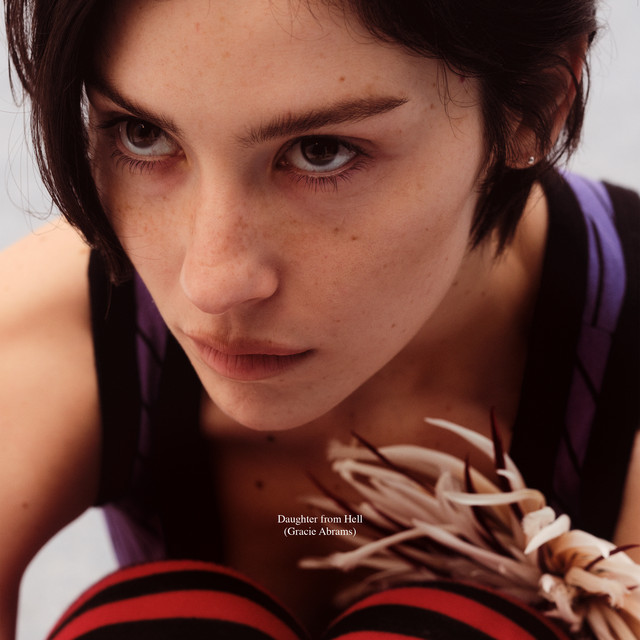
I detect two enormous biases in the critiques, largely negative, surrounding Gracie Abrams’s work. The first concerns her status as a nepo-baby, which seems to cast a shadow over how her music is received by denying any creative process: Gracie was born in Hollywood, so some argue her art cannot be the product of talent. The second targets her portrayal of female hysteria, which is accused of lacking authenticity; as if that performance were obliged to be autobiographical to feel credible.
Like Maisie Peters’s insufferable record, the main problem with “Daughter from Hell” is that it is the typical pop release that borrows the folk aesthetic and the singer-songwriter persona to imitate a depth it rarely achieves. Through a relentless stream of metaphors and constant ambiguity, many songs sketch recognizable emotions, but very few characters. You don’t need to write a diary to move people, but there is a shortage of detail and specificity.
Thus, passages such as those in “Break My Heart,” which seem to toy with the idea of suicidal ideation (“No difference to you, but you just broke my heart / And I’m gonna tell you the truth, it almost all went dark”), prefer to stay mired in ambiguity, while “Men Like You” proves too harmless in its exploration of female betrayal. And yet the track promises more.
That generic quality is felt especially in “Hit the Wall,” the era’s best single, which opens the album by leaning on tightly controlled medical and psychiatric metaphors. Here the performance of female hysteria works thanks to the superb melody crafted by Gracie and Aaron Dessner. And no, it doesn’t need to be real or autobiographical to move you. After all, that tradition of women on the verge of collapse runs through literature and music, from Sylvia Plath to Tori Amos or Fiona Apple: what matters is not how much confession there is, but how convincing the performance is. The problem with “Hit the Wall” is that its production feels too polished and calculated to convey the raw ache it seeks, even though melodically it remains a good song.
That restrained approach also informs Gracie’s entire musical proposition. Conceived with the ever-present Aaron Dessner, the album returns to the atmospheric folk-pop that follows in the footsteps of “folklore” and “evermore,” where a sum of melancholic pianos, strummed guitars, subtle percussion, and nearly imperceptible crescendos builds a drama that stays contained.
Yet perhaps the saturation of Taylor Swift’s sound prevents one from noticing that there are good songs here as well, even if the overall feel is a bit too monotonous. “Death Wish,” with lines like “Til you twist the knife with a smile while you kill me,” nudges toward a more rhythmic folk; “Look at My Life” works very well in a more synth-pop vein; and ballads like “Good Reason” or the closing “Cold Goodbyes” are simply beautiful, without needing to aspire to much more.
What’s missing is dynamism. It seems Gracie confuses making a folk record with making a flat record, and the middle stretch of “Daughter from Hell” becomes particularly arduous because songs like “Men Like You,” “Mews,” or “Affliction” sound like variations on the same theme. It’s hard to justify the album stretching to 17 tracks. When “Imaginary Friend” arrives or that whispered “Humming,” it becomes evident that Gracie and Dessner are stretching the message a bit too far.
That’s why the tracks that diverge slightly from the general line end up standing out precisely. Not only the already mentioned “Look at My Life,” but also those that explore other territories. It’s worth highlighting the title track, dedicated to her mother (“I want your metal / I want your goodness”), sustained on a base of distorted guitars that recalls some of Ethel Cain’s more accessible experiments; and, above all, “Minibar,” Audrey Hobert’s contribution to the set, which gives the album a sense of humor and a much-needed lightness.
It’s true that Gracie Abrams still doesn’t seem to have a fully formed artistic voice of her own and that her music at times sounds like an attempt to converse with the worlds of Taylor Swift and Phoebe Bridgers in order to connect with the same audience. It’s also true that “Daughter from Hell” remains too tied to a now-familiar formula and overuses predictable melodies and developments. But there are also strong melodies, mature lyrics, heartfelt performances, and musical discernment here. Is Gracie the daughter of hell? Probably not. But her performance isn’t that bad either.
