
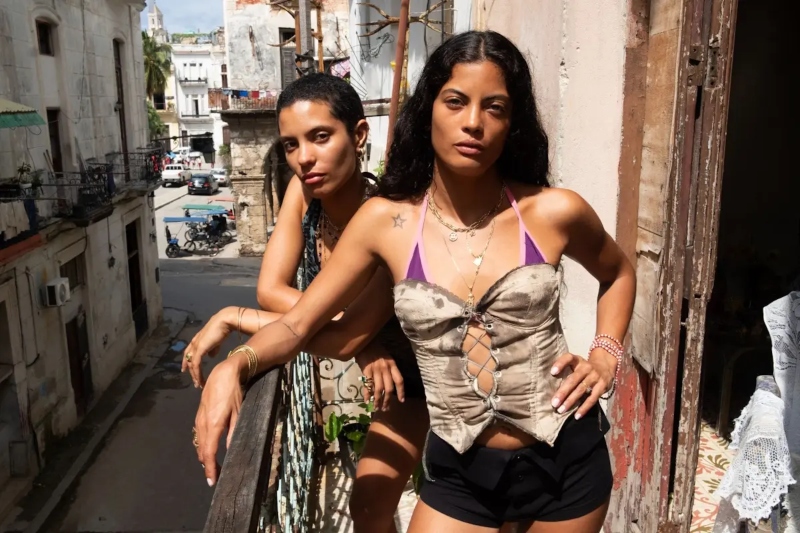
More than a decade after their debut with the wonderful “River” and after taking part alongside Beyoncé in the “Lemonade” film, the Franco-Cuban sisters Lisa-Kaindé and Naomi Díaz, better known as Ibeyi, continue to expand their path. “Offering” is their first independent album and, probably, one of the brightest and most grateful records, both musically and spiritually, that you’ll hear this summer. Ibeyi will present it in Spain on November 30 at La Paloma (Barcelona) and on December 1 at la Sala But (Madrid). Tickets are on sale. We take this opportunity to meet the sisters and talk about “Offering,” the music industry, artistic independence, and the true meaning of the word “spirituality.”
How have the last four years been for you?
Naomi: They’ve been years full of movement; quite difficult, but also very joyful. We paused for a while to reflect, to know what we wanted and how and with whom we wanted to do it, because we’d already spent ten years in this business. Like in life, sometimes you have to stop, live, think, and continue. This album gathers all the emotions we’ve gone through in the last four years, in order. It starts with anger, then moves to sadness, and arrives at acceptance and the discovery that life is beautiful.
The reflection, of course, led you to make a record. At what moment did you decide that it would be like this?
Lisa-Kaindé: We love albums, and the feelings usually arise in us as songs. When we made “Moshpit” we realized we were making an album, because we found the new Ibeyi sound.
Naomi: This record is the end and the beginning of something. We’re expanding, and it marks the start of a new era.
You highlight “Moshpit,” which is the most aggressive song on the album. Why is it a key track for you?
Lisa-Kaindé: It’s the song that releases the anger, and that’s always important: the ability to express the anger you carry inside. It was also important to write it because, in “Moshpit,” there’s a line that says: “No more pleasing, I’m the horizon.” It means: “I am the path, I no longer please anyone.” There was something in this record about realigning with what we truly wanted, without fear of what would happen. The song gave us the energy to have the courage to go out there like that.
What have you discovered about your creativity now that you’re independent?
Lisa-Kaindé: We’ve discovered that we are capable of backing ourselves. Being the only ones who believe in the project and who put the money into it, I realized the strength and faith we have in our art. We’ve also discovered that we’re incredibly hungry artistically and have countless ideas. I always knew it, but when you have to do everything yourself, you realize you can really keep moving forward.
Within the music industry system, did you find yourselves pleasing others or negotiating too much on a creative level?
Naomi: We never had to do that, but one has to adapt, and we believe independence is the future. If you can try it, you do.
Which song on the album revealed its true importance to you after you finished it?
Lisa-Kaindé: “Offerings.” We did it in a studio in three hours, with guys we had met three seconds earlier. We never saw them again, nor have we spoken to them since. It’s the quirkiest song on the album, but suddenly we realized that this was the most important thing: to focus on giving, on the offering, and not on the world’s reaction, on whether people will like it or not. Just on offering something that matters to me. That’s why the album is titled this way.
There are several references to Yoruba and Egyptian deities, for example in “Aset” or in the introduction. What meaning do they hold for you within the album?
Lisa-Kaindé: Yoruba mythology and religion are part of us and in our blood, and they will always be present in our records. It’s not something conscious; it just arises.
Naomi: If it appears, it appears. If not, we don’t force it.
Lisa-Kaindé: “Aset”… I love mythology in general, and it helps me say things I would never have dared to express in any other way. It was a kind of ego trip to be able to say them. But something magical happened: we were singing that song in the studio and I realized that the song wasn’t about me, but about Naomi. I knew she would dance in the video, that she would channel that feeling. “Aset” can be any woman who frees herself. It was beautiful to write.
Naomi: This album has always been very real, very personal. In the first one we spoke about our father, our sister who died, our mother… we spoke more of our history. This one speaks of us during these last three years. It’s not something distant: it’s the present. We wrote it every day while we were in the studio. It’s tangible. We don’t speak of a story from ten years ago, but of the moment we were living. That’s why the tracklist follows a chronological order reflecting what we were feeling.
It’s evident that the album splits into a first part with more anger and a second, calmer part, but you say it emerged naturally.
Naomi: I think most albums start calm and grow stronger. Retrospectively, it’s interesting to have taken the opposite route: starting with anger and ending with peace.
“Without spirituality you can’t survive in this industry. It’s very powerful. You have to have faith. You have to know who you are to stay centered.”
In the album you mix languages, as always, but I wonder if there are certain emotions that come out more in one language than in another.
Lisa-Kaindé: Some songs have to be in Spanish and others in French. Each language has its own energy. For example, “La tendresse d’un mot” could not have been in Spanish. It’s our first entirely French track, and we feel very exposed. It’s us truly opening up our hearts.
Naomi: Spanish is much more poetic than English. For example, the song with pablopablo, “Good Life”… when you try to translate it, it’s a catastrophe.
Lisa-Kaindé: English is much more direct, more “straight to the point.”
Earlier you mentioned Yoruba deities. Do you feel spirituality is compatible or incompatible with being in the music industry?
Lisa-Kaindé: Naomi has a lot of trouble with the word “spirituality”; she doesn’t like it at all. I think she feels that being spiritual doesn’t mean praying every day or burning incense. She expresses her spirituality by dancing, for example.
Naomi: I think the word has become viral, and that many people, when they think of spirituality, think only of one thing, the image you see on social networks. I never use that word.
Lisa-Kaindé: To answer your question, without spirituality you can’t survive in this industry, which is very intense. You have to have faith. You have to know who you are to stay centered, to live in the present. All of that is spirituality. You have to find the passion and the beauty in what you do.
Naomi: For some people spirituality can be in a strip club doing twerking, in Tibetan bowls, in traveling, or in making love.
Do you find it annoying to be associated with that word because it labels you?
Lisa-Kaindé: It doesn’t bother me at all. I do consider myself very spiritual. Naomi finds it a bit harder.
Naomi: Yes, because I don’t like labels, but I understand that the word gets used.
Lisa-Kaindé: It’s not that the label isn’t true; I just think its definition should be broadened.
Do you feel the industry romanticizes your sisterly status and overlooks your individuality?
Naomi: I think people are starting to know who is who. First with “Aset,” which represents more my energy, and “Offerings,” which represents Lisa’s. We’re twins; it’s normal, but it’s also our job to show who each one is.
Lisa-Kaindé: And it’s our job to grow individually so we can show those two sides. We are very different.
Is there any significant influence for you that the press rarely mentions?
Naomi: I love architecture and furniture design. I always want the videos to be shot in architecturally beautiful places for people to discover. Perhaps in a few years you’ll see me designing chairs or furniture.
After a decade in the career, which external expectations are hardest to ignore?
Naomi: That is something we’ve left behind. There are still expectations, but I’m much more relaxed now.
Lisa-Kaindé: This album is like a map, because everyone experiences what we sing about: having low moments, wondering where it’s going… We wanted to show that ego and vulnerability can coexist perfectly.
