
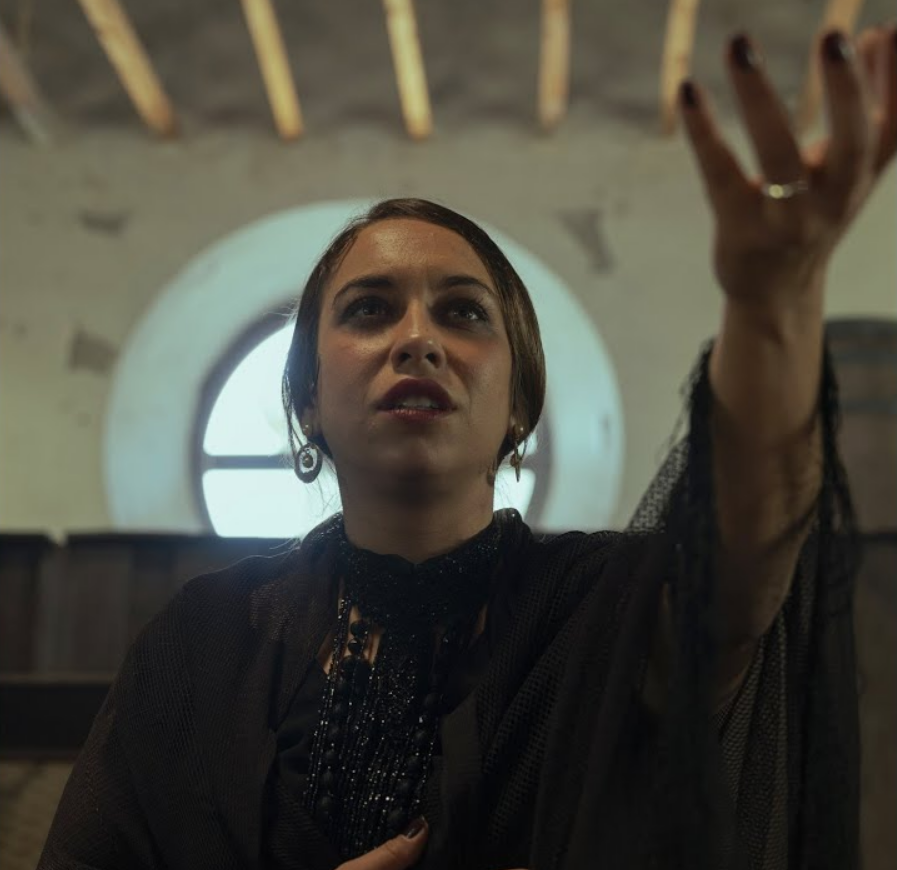
If you have seen “La Bola Negra” (The Black Ball), you probably remember the one-shot scene of Carlos (Milo Quifes) dancing. It has been one of the most talked-about moments in Los Javis’ film, celebrated for its technical prowess as well as its emotional depth. If you’ve ever wondered who the cantaora is in that widely discussed scene, your questions can finally be laid to rest.
María Terremoto, in collaboration with Raül Refree, is among the artists contributing to the original soundtrack of “La Bola Negra,” now available on streaming platforms, performing the distinctive “Seguiriya de los valientes,” our Song of the Day. At the same time, she is one of the protagonists of the iconic scene, which also marked her screen debut.
We spoke with the artist about growing up with Los Javis’ works, the instructions they gave her for acting, the behind-the-scenes moment of the scene with Milo Quifes, the meaning of the seguiriya, and Lorca’s legacy. In addition, we dissected the rest of the film in the latest episode of Revelation or Scam, with Enrique Aparicio.
Your first role is in “La Bola Negra.”
Yes. It’s a dream, really, because I never expected, not in the slightest, that my small but intense moment in the film would have that kind of reach and the reaction it has provoked. I’m very happy.
Tell me, from the beginning, how this became a reality.
It was a twist of fate with Raül Refree at an event organized by Carolina Herrera last year here in Madrid. We were performing at a pre-show event at the Palacio de Liria. Raúl and I clicked, and he told me he was working on the film’s soundtrack and that there was a scene needing a cantaora. That information stayed with me, and over the following weeks my office also touched base with Raúl, Raúl with us, and in the end, thanks to Raúl I was able to get the opportunity to record that scene with those amazing directors, whom I admire enormously and whose career I’ve followed almost in full.
That’s what I was going to say, we’re from the same generation and we’ve basically grown up with their series.
Of course, and with “Física o Química.” Don’t take offense, Calvo, if I say that, but I’ve followed them since Fer.
When did you meet Los Javis?
Javier Calvo was the first one I met. It was at his house, aligning the lyrics a bit for the song we were going to do. I was honestly very nervous because, as I’ve said, he’s a person I admire and whom I’ve nearly watched everything he’s done. Very kind, Javier. He treated me well, with a lot of affection. He made it very easy for me, and I met Ambrossi on set. I didn’t have the chance to meet him earlier, but he’s also a wonderful and easy-going person. For me, even though I hadn’t done anything in film before, it was a very pleasant and comfortable experience.
Did they give you any concrete notes?
Yes, of course, mainly about the emotion in the singing. About “Where do you come from, love, my child?”, which is a poem taken from Lorca’s Yerma and included in the first part of the seguiriya. They wanted a specific intonation. I felt a bit embarrassed even delivering that intonation and pronunciation in the verse, but well. Once you listen to the poem and then the seguiriya you see that it makes a lot of sense. Obviously, because they know exactly what they are doing.
“When something is of such emotional depth, you come to feel it to the point of actually living it.”
Milo Quifes said the scene is fully choreographed. I imagine you did too, especially the moment when you cupping his face.
Well, not really. I hadn’t rehearsed it with Milo. I was rehearsing, I can’t remember if it was a day or a week before, and Milo wasn’t there. Belén was there, the choreographer. She’s wonderful, incredible, spectacular. It was just her and the dancers, so I saw Milo only during filming. There, Los Javis told me to interact very little with him. I love acting; I’m very cinematic, very melodramatic. I adore it. In the end, when something is so emotionally deep, you reach to feel it to the point of living it. I immersed myself in the ecstasy of the moment, in the atmosphere that was there, which really was quite profound. And that small detail where I stroke Milo’s face came out.
Just that—I was going to ask you: did you experience it as playing a role or as a musical performance in the traditional sense?
I experienced it as the portrayal of a role, because they also explained to me what I represented. My part is symbolic; it isn’t a real person. If you’ve seen the film, you know that in that moment I’m like the conscience of the other woman who doesn’t have her child and is watching Carlos, wavering between yes and no. If you look closely, there’s a tiny detail where a white ball is handed to Carlos during the choreography, but you must stay very focused. That’s where you begin to grasp the film’s context, when you understand that Carlos is trying to accept himself, but he really can’t. I find that detail wonderful.
The ‘Seguiriya de los valientes,’ that’s what it’s called. I’ve read that it’s an original composition by Refree.
Well, the lyrics I sing are traditional. What might be more coming from Refree’s mind is the arrangement, the way it’s played, the way it’s expressed… but really the song itself is something very traditional within flamenco that has passed through all the cantaors of flamenco’s history, through the masters from whom we learn and draw.
Why was it important that it be a seguiriya and not another flamenco estilo?
For someone who understands flamenco a bit, or who likes it even a little, the seguiriya is a palo that has long been tied to feelings of sadness, sorrow, anger, rage, agony, pain, and loneliness… I think Refree was very clear that he wanted it to be a seguiriya, and I believe he already understood the scene’s context. It couldn’t have been a better choice, because that is what you see in the scene. It’s a catharsis, and, in the end, the seguiriya gives it that depth and that anguish Carlos feels in that moment, not knowing where to turn. Also because of Mona Martínez’ moment, crying for her son, mourning his death.
For people who don’t know much about flamenco palos, can you explain what characterizes a seguiriya?
To me, the seguiriya—for the place I come from and the family I come from (my grandfather was one of the greatest interpreters of this palo in flamenco, and my father was a cantaor)—means something very, very big and deep. It’s a song that, for example, I identify with my most negative experiences, such as my father’s death or certain events that occur throughout life. I associate it strongly with that and perhaps, beyond its rhythm, which, in flamenco, all the rhythms are like first cousins and have something in common, what characterizes the seguiriya—or what I hold onto—is its solemn harmony. You will never hear a seguiriya sung talking about love directly. It can speak of love, but it will tie it to heartbreak, betrayal, death, or sorrow. I also love its darkness, its dark world, but in a positive sense; to be clear, I don’t like occultism or anything like that. It scares me (laughs). I’m drawn to solemn things, and that’s why the seguiriya is a special palo. I don’t always sing it in my repertoire because I feel I need to be ready for it. Singing in seguiriya means arriving at a gig with one’s head completely spent, or with a heavy heart, or with the desire to vent. The palo deserves at least a minimum amount of emotion.
“When you do things from the heart and with genuine enthusiasm, and you reap that fruit, I think it’s much tastier.”
Obviously, Lorca’s figure is crucial both in the seguiriya and in the film. Does it strike a chord with you?
I think Lorca touches the heart of everyone who loves literature. He is also the emblem of Andalusian poetry. In school, poems of his would be recited on February 28 or plays performed. The first work of Federico I encountered was “Blood Wedding,” which is deeply tied to flamenco. I was six or seven, and I didn’t truly grasp Lorca’s depth. Remembering him sends goosebumps down my spine, because I find it marvelous that a seven-year-old girl could be captivated. Not even for the prose, since I didn’t have the necessary reading comprehension. As I grew older and bought his works, something inside me formed. I think his honesty, his truth, and the realism in what he expressed through poetry left a legacy that I believe is hard to extinguish. To this day, after so many years, Lorca remains alive in the hearts of our generation. Lorca is one of the greatest artists we have in this country.
The film has been an overwhelming success, and I wanted to know not only how you’ve lived the film’s reception but also your scene, which is one of the most clearly discussed.
If I’m honest, man, I can’t quite wrap my head around it. From the bottom of my heart. I’m not saying this to be modest; truly not. I mean, I am only a quarter of the film, and I don’t think I deserve that level of credit because I was there for one day, six hours of filming, while others spent days and days at it. Neither my body, nor my mind, nor my heart, nor that inner child I carry there have fully absorbed it yet. Everyone is saying it’s one of the best scenes in the movie; people, especially flamenco lovers, have told me they went to the film just to see my scene… What is this? What’s happening? I like to experience it this way because I think that, in the end, when things come to you and you’re not aware, you embrace them more strongly. When you expect something or believe it will come, perhaps because you crave it, you don’t feel the same thrill and it doesn’t arrive in the same way. When you do things from the heart and with enthusiasm, and you reap that reward, I think it tastes much sweeter when you take it in.
