
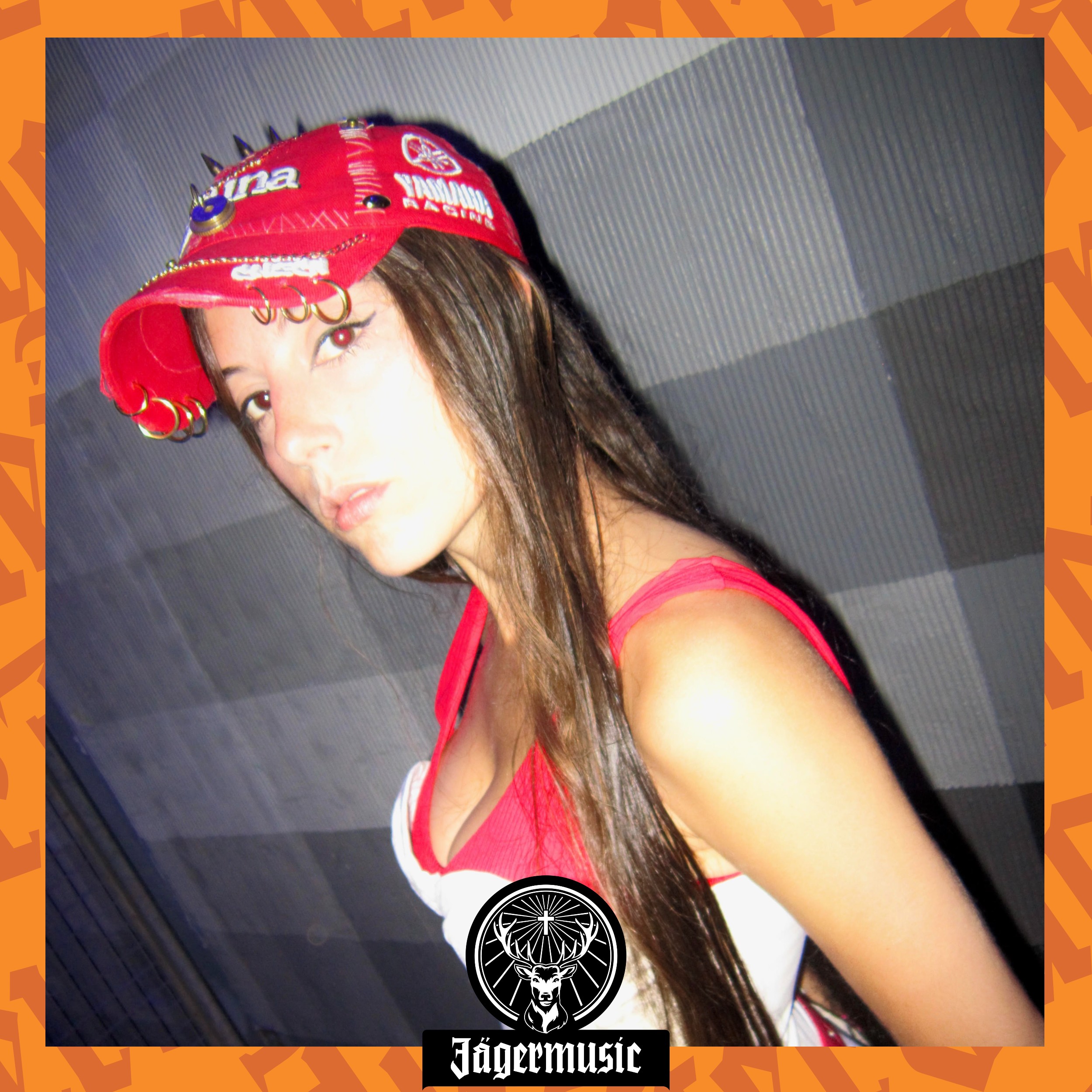
Meritxell de Soto is one of the artists actively breaking down boundaries across different artistic disciplines. Labeling her as a DJ or a performer would be reductive. She has DJed at spaces like Sónar and TAremor, and as a performer she has appeared at Teatros del Canal or the CCCB with the LASADCUM company, and she has also participated in conferences and trade fairs reflecting on gender construction and identity or traditional masculinity.
Invited to MEISTER OF THE WEEK, our section curated by Jägermusic, Meritxell de Soto has decided to talk about literature. In the conversations prior to this interview she already cited as a favorite the character Ophelia in Hamlet or magical realism.
Why did you choose to talk about literature in this interview? Since when have you been so interested in literature, and when did you have that “crush”?
It’s a fascination that has accompanied me since I was very young, and I love sharing it. I think it begins strongly in two moments: the first was when I finished my first book on my own, which was a child-friendly adaptation of the Bible. I remember perfectly the feeling of finishing my book by myself and having lived an experience with characters who, in theory, would never be in my life again, who wouldn’t exist beyond their pages… Or perhaps they would, haha.
The other beautiful moment was when I was 12 or 13 and a schoolmate gave me two books. Her family was very bookish, her name was Griselda, and I devoured one of the two, which was a young adult novel, ‘Por 13 reasons’, which years later was adapted for TV. I recall feeling such a strong longing to keep discovering all those things that I went to the village library. There I met Anna, a librarian who worked in the young adult section, and we became friends. We started to have a very lovely relationship. I would go to the library once a week or every two weeks, and she had a list of books prepared for me that she thought I might like, because she had gotten to know me. Then she showed me two or three books from the list and I chose the one that interested me the most, read it, returned after a while, we discussed it, and she recommended others. And so on for a long time.
You told us that you have always been fascinated especially by the figure of Ophelia in Hamlet. Why?
It wasn’t something chosen, but it arose in me, although later I understood a bit why. I read Hamlet at about 17, and the character of Ophelia obsessed me completely. It’s a character whose moment of glory really comes not when she appears, but after she dies and her death is described. That famous image of Ophelia’s painting by John Everett Millais. Delving into that figure, which generated an absolute obsession, I realized that Ophelia was actually a reinterpretation of the figure of the classical nymph, which had also obsessed me a lot during my childhood: the nymphs and Greek and Roman mythology.
From there, I started a whole drift in which I sought interpretations or reflections of Ophelia in literature. I needed to make that character live or find her elsewhere, such as in Bertolt Brecht’s The Ballad of the Drowned Girl. And all of that led me from the figure of the nymph to the transmutation of Ophelia, to the figure of that suicidal nymph who ultimately manifested for me in figures like Sylvia Plath or Virginia Woolf. They were passions that followed my obsession with Ophelia, but I feel that, in a sense, they are very connected to that figure.
In the end, they are women who decide, of their own will, to end their lives, but there is also a gaze and a patriarchal structure surrounding them. If we recall Hamlet, Ophelia commits that act after Hamlet rejects her and tells her to enter a convent, after also theoretically falling in love with her and sharing his intimacy with her. And, in some way, I believe Sylvia Plath and Virginia Woolf were also victims of a system that was unjust to them because they were women.
«The figure of Ophelia, for me, ultimately manifested in figures like Sylvia Plath or Virginia Woolf. Victims of a system unjust to them because they were women»
Do you think it has influenced the development of feminism in later centuries, or the way female characters are viewed?
For me the figure of Ophelia is very connected to that reading of the patriarchal condition and to how certain female characters have been constructed and represented throughout history.
Ophelia has also fed into pop music: Taylor Swift’s latest hit, a Florence + the Machine track inspired by Frida Kahlo’s painting What the Water Gave Me… Do you have a favorite pop reinterpretation?
I don’t know the songs that are mentioned, and as for Frida Kahlo, I’ve never delved deeply into her work, though I recognize her value and contribution very much. I think that, in some way, Ophelia, the nymphs and this whole transformation of characters that have shaped my imagination have also left their mark aesthetically. It’s an imagination that, in a sense, is partly reflected in the visual universe of my project.
Do you read a lot of theater, besides Shakespeare? Do you think reading it is a bit out of fashion compared to seeing it performed?
Theatre has been a discipline very, very important in my life. Before I dedicated myself to music, my intention was to pursue theatre, theatre and not cinema or video. It’s a medium that has always fascinated me and has generated a great obsession in me, and I suppose that’s why I have developed most of my practice around performance and dance. I have read a lot of theatre. I like reading theatre; I’ve always enjoyed it. The last theatre text I read, at the recommendation of a very good friend, Uri, who always suggests incredible things, was No Exit by Jean-Paul Sartre. That’s where that line ‘Hell is other people’ comes from.
There are several theatre figures that have obsessed me and that are related to each other. The one I suppose most captivated me, due to his charisma, his lasting influence in history, and also because of the deep contradictions in his texts, is Antonin Artaud. And that also sparked a great obsession with Polish authors such as Jerzy Grotowski or Tadeusz Kantor. But I really think what obsessed me more than their theatrical works was their theatre and philosophical trajectory, because in the end all those authors oscillate a bit between theatre and philosophy, and they bring non-naturalistic theatre, which is the kind of theatre that has always interested me the most and that I also enjoy watching, obviously due to its historical and social context.
«‘Pedro Páramo’ changed my life»
Another one of your favorite books is Pedro Páramo by Juan Rulfo. It was a mandatory and very disconcerting read when I did COU and Selectividad. How did you discover it and why did it inspire you so much?
I wish Pedro Páramo had been mandatory for me! That would have been amazing. I found it in the bookshop belonging to a friend’s mother during my teens. I hadn’t yet read anything by Latin American authors from the 20th century, so it was my entry into that universe, and it was a fantastic entry, because I think it’s a foundational book for this whole movement. Pedro Páramo obsessed me completely. I think there is something in that choral voice, in the voice of the people, in how a story can be told from different perspectives, that I liked very much. I discovered magical realism and it fascinated me; it obsessed me completely.
I suppose it reflects a view of the world that I find very beautiful and very painful at the same time. It might have to do with this matter of contradictions, which has always been a motive for my obsessions. I saw that opposition echoed in the texts and I think that’s why they captivated me: encountering such human characters. I also think that in a text like Pedro Páramo the tradition is preserved very well, but from a place that isn’t as distant from us as reading Shakespeare or Goethe might be. It’s a place seemingly less artificial. In the end, they are absolutely poetic texts that generate images of a brutal transcendence from words that can be very ordinary. Pedro Páramo changed my life, literally. I could say it’s one of the texts that has shaped me the most and that I have reread the most.
In One Hundred Years of Solitude there is a magical component, but also folkloric, warlike, and soap-opera-like… What is your favorite part of the book? Why do you think it has become a classic of literature?
If I had to pick one moment from One Hundred Years of Solitude, I would undoubtedly choose the story of Meme and Mauricio Babilonia. There’s something about that romance, that passion… It’s very hard to explain with words, because I think it reduces the feeling that reading it gives you. And it is certainly one of my favorite moments in the novel. I think One Hundred Years of Solitude has become a classic of literature because it is inevitable, don’t you think? It’s one of the most apotheotic books ever written, from my point of view and from what I’ve come to know.
It’s also a book that has influenced popular culture: a series has been made and Shakira named her Madrid stadium “Macondo.” Any adaptation worth mentioning?
I’ve never really been a big fan of adaptations, because when I was little I read The NeverEnding Story and then watched the movie, and I was so deeply disappointed… It was a book I had really liked and with which I connected closely to the main character.
I also felt the same with Breakfast at Tiffany’s by Truman Capote, which I think is an incredible text and impeccably well written. The main character is utterly human, but I think there’s something in the film industry, that tendency to return characters to being too perfect within the canon, that ends up dehumanizing them. And that makes me lose interest.
So I wouldn’t be able to name an adaptation that marked me in a special way. I’ll stick with the book, because I don’t want to see that image I have, that memory the reading left me, undone.
«The NeverEnding Story films and Breakfast at Tiffany’s deeply disappointed me [after reading the books]»
Any lesser-known magical realism book you’d like to recommend?
Well, magical realism doesn’t immediately bring a specific title to mind, but the first one I’ve thought of with this question is a fairly unknown, quite recent book called Autofagia (Autophagy) by Celia Lorenzo, a Canary Islands author. It’s a short little book that leans on or accompanies all this trajectory that has grown out of Panza de burro, and it’s infinitely well written. She is a very young writer, and I think she’s one of those voices worth discovering.
Is it common in the DJ, nightlife, or performance world to discuss all these things with your peers, or is it a rarity in the scene?
Yes and no. I mean, really, in the end, the DJ is a curator and, therefore, in a sense, an archivist of music. I suppose that also leads you to take an interest in other disciplines and to cultivate the desire for knowledge and references. It’s true that perhaps I’m using the opportunity to say this here, to the magazine, in case someone suddenly wants to join me in this, but for quite some time I’ve wanted to find people, maybe in circles where we can talk about books and share texts. Because I think these are the conversations that move and excite me the most.
