
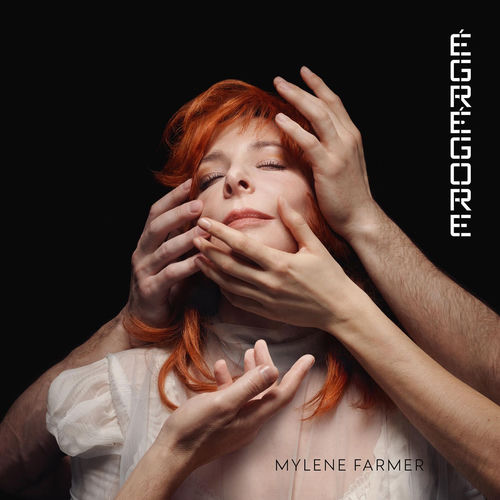
Is it possible that four years have already passed since Mylène Farmer’s last studio album? Yes, it is; but the most astonishing thing isn’t the swift passage of time, but that after nearly half a decade and at 65, the artist remains perennial, with no apparent cracks in her voice or in her powerful creative energy. This energy includes her ability to find collaborators with whom to elevate her lyrics and her baroque-pop vocal tessitura to heights that do not diminish her previous work.
From this point of view, it can be said that Farmer again hits the mark with the new team of writing and production behind Égrégore. Just as on L’Emprise she wisely allied with Woodkid, in this new album her main support are Jen Jis and DJ Lewis (one of the producers of Drake’s “$ome $exy $ongs 4 U”), in addition to the inevitable Moby. In the writing process, large teams of songwriters manage melodies that sit in a mid-to-high range, with some outstanding examples.
The first two previews (which open the album as well) would clearly be among them: excellent melodies wrapped in efficient production, and in which Mylène handles the vocal lines admirably. The somewhat boomer-ish complaint about the decline of the French language in “Des lols et des quois” still carries a certain irony: Mylène laments that the words “have laid down their arms” and that Pierre de Ronsard rages in his tomb, yet she cannot resist declaiming those supposed linguistic impurities in the final verse of the song. Not to forget that here, even though she critiques words like “ouf” (verlan is the reverse of “fou,” a hallmark of the inverted slang known as “verlan”), Farmer herself had no trouble inventing verlanisms like “zoprack” (“Prozac”) in her 1995 single “L’instant X.”
“C’est à qui le tour” is even better, a solid candidate for a Farmer-esque classic of the new century with magical melody and rhyming wordplay that also seems to mourn the death of the word (“the text is dead, context, effort / The water that sleeps”) over evocative melancholic electropop. It’s also helped by the impact of the intriguing video by Julia Ducournau that accompanied the release.
And so, through the first half of the album, there are sequences with more evident impact: potent bangers like “Reste le lumière” in which the crystalline timbre of Mylène shines, and strong melodies in the mid-tempo “Égregore” or especially in that excellent ballad with the right dose of eighties epicness that is “Entendre ma voix” (Ana Zimmer undoubtedly co-signs the best melodies on the album).
Here would also fit the first of the two collaborations with DJ Snake, the mastermind behind mega-hits “Lean On” and “Turn Down for What,” although honestly “Combien pour la nuit” has more shell than substance: a much more interesting outcome would have been the rumored Angèle collaboration that never materialized. The slow track “Sans amarres” sits mores solidly, with perhaps confessional lines from a vulnerable Mylène: “I felt an emptiness right away / When the darkness lurks around the word ‘fragile’ (…) Maybe my world is too blurry / I live upside down, with my feet in the clouds / There are no words when courage is needed / That’s why I endure for so long / I feel alone among the people.”
The second half of Égrégore opens and closes with productions by Moby, who on L’Emprise contributed the least interesting part of the album. It is, however, fair to acknowledge his contribution to this new record: the synthetic orchestras of “Récréer un jour” and its ninety’s beat, against all odds, recall The Cure’s orchestral duel, as if the song were a sort of europop reverse of “Alone.” “Plus d’echo” closes in an equally solemn fashion, with a lovely melody and violins.
In the middle, a second act dominated by mid-tempo songs and ballads. The airy “Déni” is pure delicacy, as is “Confession,” her homage to David Lynch of 2025 that is appropriately revived here, and which fits perfectly with the mood of this portion of the album, with its gorgeous vocoded harmonies.
In this final section only “On a toujours le choix” is properly uptempo. It also has hit potential, with echoes of Mylène circa “Innamoramento” and lyrics that move between despair at the world (“humanity no longer makes sense / Breathless and tired / I lament this lethal world”) and faith in change: “That things can be changed / And in the name of the rose / One can sing to the winter / Dance in the sky / We always have the option / There’s a spark there / To love you, freedom.” Perhaps an anthem for this autumn of antifascist resurgence? I have already adopted it with that intention.
Just as the Mylène of the clip for “C’est à qui le tour” looks in the mirror and sees her 1986 self (the one from the “Libertine” video), the Mylène of each album in the last decade and a half looks musically toward her earlier selves: there are predictably glorious eighties-esque pads and keyboard riffs (“Entendre ma voix,” “Déni”), characteristic arpeggiators from the early 2000s (“On a toujours le choix”) or exotic flutes from the old Fairlight of “Cendres de lune” (“Sans amarres”). All are enveloped in the magnificent digital reverbs that, like stardust, one expects in every album by the iconic Franco-Canadian; her voice remains colossal and there are no missteps that sometimes derail her albums (experiments with rock, songs in English).
All of this, combined with the compositional inspiration across almost the entire repertoire, makes Égrégore a very good album. The concept alluded to by the title refers to a force, an emotion, sparked by the communion of a group of people, a notion popularized by Victor Hugo in the poem “La Légende des siècles.” In the original Greek, it means “awakening, uprising.” With this thirteenth album, Mylène proves she remains capable of conjuring that égrégore among her vast army of followers. And may she continue to do so for many years to come.
