
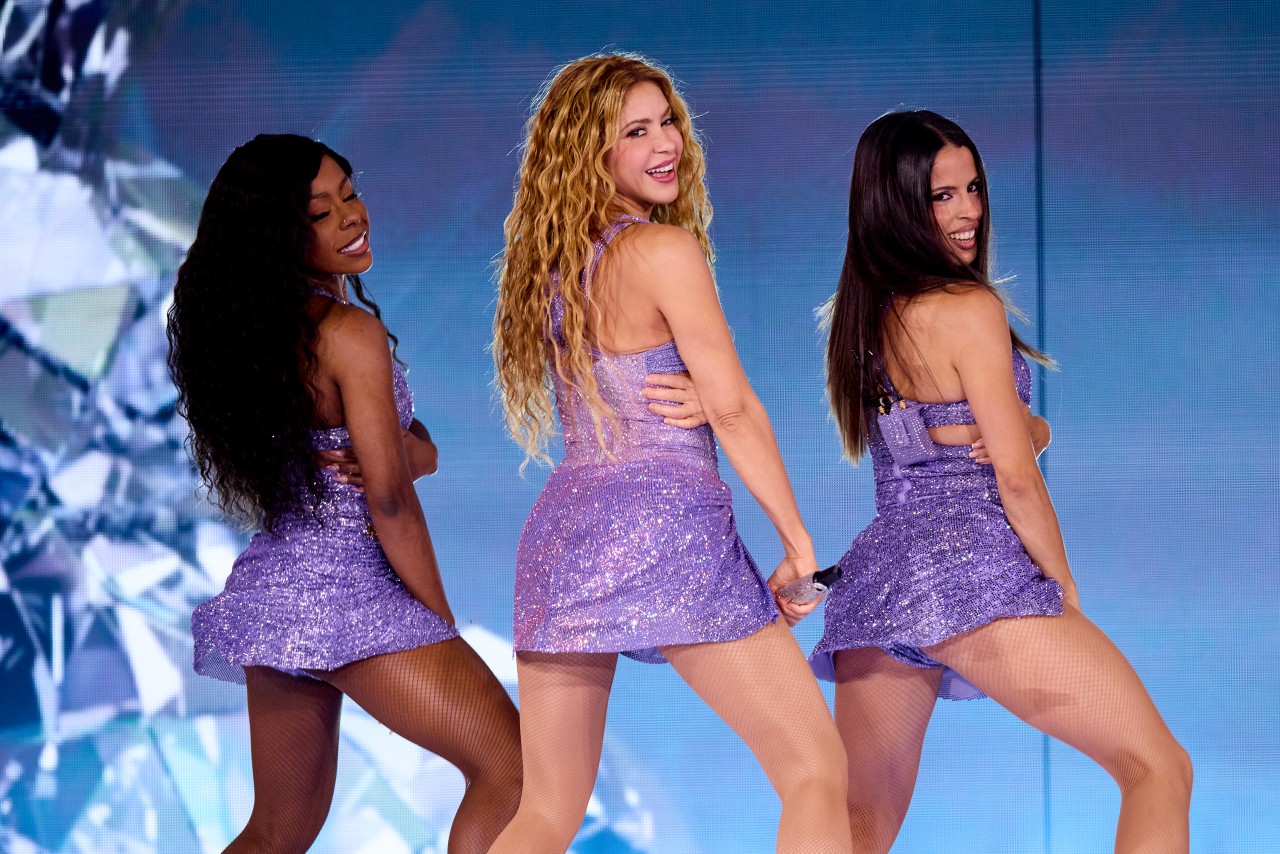
Shakira arrived in Madrid last Monday, as early as four days before beginning her residency in the city, a move that is far from common on a tour. It isn’t exactly the first stop of her tour “Las mujeres ya no lloran” —quite the opposite, it’s almost the last— but the occasion deserved it. In Madrid, an ad hoc “stadium” has been erected for a 12‑night residency. The venue, Iberdrola, is well known to Madrileños for hosting Mad Cool, but the twist is that, in addition to three sizeable grandstands being mounted, a small complex has been built to pay homage to the artist and also to entertain the younger visitors.
There are drink and food stalls, a Disney tent, a museum with photos and platinum discs of Shakira… there are even literature workshops and parallel stages with performances both more and less professional. I lose track of Lia Kali, the day’s opener, not so much by schedule as by sense of place. The 55,000 attendees —mostly women from many countries— meander all afternoon while videos and ideas about Shakira are projected. For example, what phase of the moon we’re in. Everything appears saturated with the most improbable stimuli.
I had my doubts that all of this could be given the ambitious name Macondo, like the imaginary village in One Hundred Years of Solitude. Let’s say there isn’t much magical realism in Shakira’s universe. Yet there is magic in the atmosphere. The singer has managed to translate the emotion usually felt outside a stadium into this unreal microcosm, something I don’t recall witnessing before. That must be the common thread with Gabriel García Márquez’s masterpiece… or perhaps it’s that for the price of a mini beer (13 euros + 3 for the cup) you can buy all the animals that are auctioned in the book.
The experience is so exceptional that it’s almost a pity when the concert begins, but it does so with a 15‑minute delay. The show is what you would expect from a Shakira spectacle: a lot of hip movement, a lot of color, a lot of charm, a strong Latin flag, little paraphernalia. The limited, robotic choreography of ‘La fuerte’ and ‘Girl Like Me’ signals that we won’t be witnessing the most ambitious and meticulous production in the world. On the contrary, the instruments and voice are mostly live, and the panoramic screen is gigantic and impressive. Although Shakira may appear like a tiny figure at a distance, you don’t miss a single gesture or smile, and in truth she’s radiant. “People tell me a lot: ‘Shaki, with what face you left and with what face you returned,’” she confesses, referring to her highly publicized divorce.
There is a great deal of pure hedonism in many of her songs. ‘Dai Dai’ and ‘Waka Waka’ ring out toward the end of the show; ‘Hips Don’t Lie’ remains an astonishing production. But most of the night revolves around the moments when her heart was broken, and how she rebuilt it. Not only Piqué. She recounts how a boy with cheerful eyes from the city became the recipient of ‘Te quiero, Madrid.’ Old songs like ‘Inevitable’ are sung with such fervor by my seatmates that I feel compelled to change seats discreetly. All the versions of Shakira are celebrated—the balladeer and the evergreen party‑goer, the reggaetonera and the rocker—except perhaps the one that sings in English. ‘Empire,’ ‘Don’t Bother’ and ‘Can’t Remember To Forget You’ are among the night’s more overlooked tracks, despite a projection featuring Rihanna in the latter.
Without grand staging tricks—the bicycle in the show is built by humans—the only moment of surprise comes with ‘Chantaje’. Without Maluma or his presence, Shakira has injected salsa into a revised version, with a dance troupe and a witty number where we watch her changing outfits backstage. Now it resembles a Gloria Estefan song, and in this case that’s praise. Her children appear projected in ‘Acróstico’ because she wrote it with them. In ‘Soltera’ she salutes all the stadium’s same‑tempered fans, doing a pole dance. Not much more. The spotlight falls squarely on the hits. But, after all, how many does she have?
‘Las de la intuición’ and ‘Estoy aquí’ are hammered into a brutal medley; as are ‘Te felicito’ and ‘TQG’. Yet how brightly ‘Loca’, ‘Suerte’ and ‘Pies Descalzos’ shine. And how good, how incredibly good was ‘La Tortura’, even if some of us hadn’t realized it before.
The encore gathers ‘Loba’ and its Bizarrap session, because the songs were connected. Just to see Shakira finally sing about Piqué, about the mother‑in‑law and the tax bill, would have justified all this residency. Clearly it’s been better than it sounded. I burn to find out who will be the first to imitate the idea. 7.

