
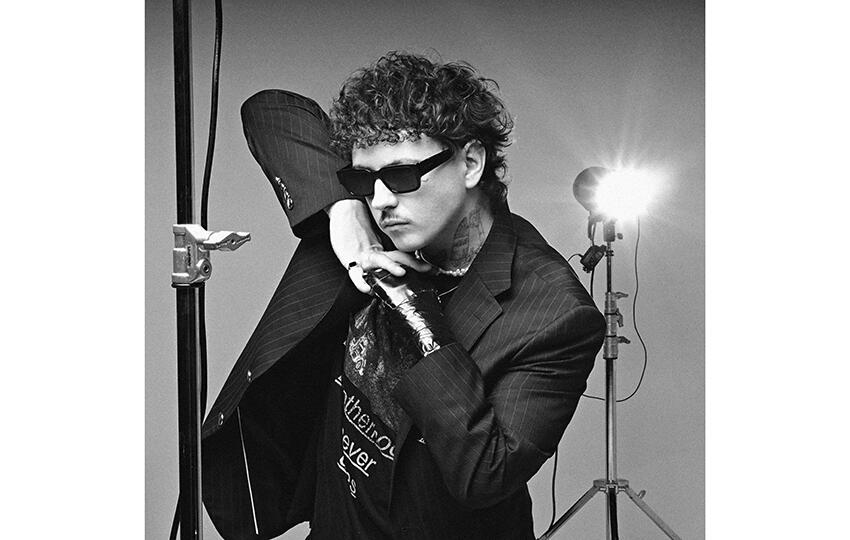
Under the leather jacket and dark sunglasses, the Saint-Etienne-born artist shows a striking fragility, nourished by rock idols like Oasis, Blur or The Strokes.
Since his mixtape French Cash in 2019, a condensed blend of new-wave rap and scarred pop, Zed Yun Pavarotti revealed a universe in tension, torn between popular roots, excess and a quest for spirituality. While the themes of the Saint-Etienne artist remain the same in Unmiracle, the packaging has radically changed since the albums Beauseigne (2020) and Encore (2023).
Out go the subs, the TR-808s and the Auto-Tune: the musician now leans toward rock idols like Oasis, Blur, The Strokes or Fontaines D.C., but also toward almost sixties arrangements. A metamorphosis that is both the strength and the weakness of the record: the crowd-pleasing chorus lines at the end and the razor-sharp guitars are still a pleasure to hear, but the stance is never far away.
A Withered Poetry Still Pierced by Love
Under the cliché leather jacket and black sunglasses, it only takes a few listens to realize that Charlan Zouaoui-Peyrot has not lost any of the power of her writing, with withered poetry, infinitely sad before the inevitable but always pierced by love – in all its forms.
From the tubey opener Si Dieu fume (a title Bashung would not have disowned) to the twilight ballad Sorry, from the bittersweet tenderness of Quand est-ce qu’on oublie qu’on aime in a duet with Marguerite Thiam to the clenched jaws of Paroxetine, Unmiracle contains its share of very good songs. And its breathless finale, though exhausted, overflows with vitality, reminding us that beneath certain masks, Zed Yun Pavarotti’s music retains an extremely touching fragility.
Unmiracle (Entreprise/Sony Music). Released on November 6. In concert at the Olympia, Paris, on February 17.
