
A major rendezvous in the field of contemporary creation, the Barcelona festival — always in search of reinvention — delivered an intense 33rd edition, throbbing with multiple pulses of varied hues.
Created in 1994, Sónar entered a new era following the departure, announced in October 2025, of its founding trio (Sergi Caballero, Enric Palau, Ricard Robles). Originator of Brunch Elektronik-labeled events, the Belgian François Jozic now oversees the festival’s artistic direction. This handover is accompanied by a symbolic change. For the first time in the festival’s history, the entire 2026 program — day and night — unfolded at the same venue, namely Fira Gran Via, a vast exhibition park on the outskirts of the Catalan capital (already used for nocturnal celebrations since 2001).
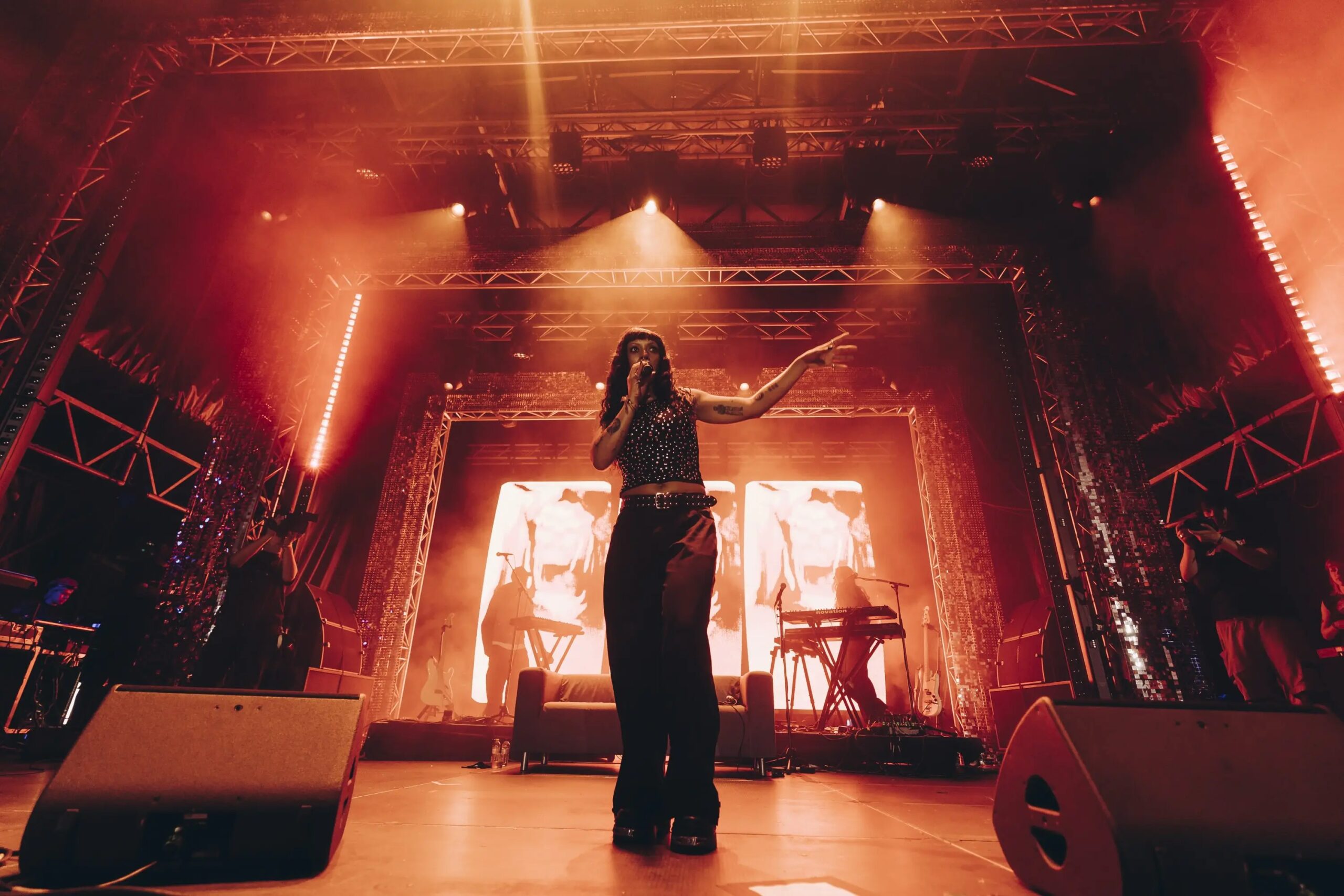
Six stages of varying sizes had been set up, three outdoors (SonarVillage, SonarPark, SonarLab) and three indoors (SonarClub, SonarHall, SonarCar). All performances, live or DJ sets, were enhanced by sophisticated stage setups with lighting and/or video projections. On the musical side, a wide range of electronic currents was represented, with a marked preference for the more provocative and energetic acts. The lineup also included two visual artworks, including Organysmo by the LedPulse collective (a massive sound-and-light installation in constant mutation), both part of Sónar+D — the portion of the festival specifically devoted to digital arts.
Cité de rave
Very well organized, the whole experience gave a dizzying sense of wandering through a rave city that thrums intensely throughout the festival. Taking the shape of a small club set up under a tent in one of the site’s vast halls, SonarCar quickly appeared as the reactor core of the operations. Here one could discover three variants of Stoor, a 100% live collaborative project in improvised mode orchestrated by Speedy J, a renowned veteran of the techno sphere. On the program: a live performance — lasting at least five hours — by Speedy J with four playing partners (the lineup changing each night). Fusing with the music, visual creations were projected continuously on the four faces of a tall rectangular structure suspended above the stage. The audience surrounds it, thus enabling a fully immersive experience. Saturday’s session — featuring Dasha Rush, Luke Slater, Mathew Jonson and Phase alongside Speedy J — formed the ecstatic apex of the project, the ephemeral quintet delivering a powerful organic techno, with very subtly crafted contours and contrasts, over the course of seven hours.
Dance Deluge
At SonarHall, The Hacker’s DJ set also fit an immersive Boiler Room-style setup, and managed to make the crowd sway under a dark yet danceable surge — between electro, new wave, EBM and techno. In a brief interview backstage, the French musician spoke about his relationship with Sonar and with Barcelona. “I first played at Sónar in 2000, with Caroline (aka Miss Kittin) as part of a Gigolo Records showcase,” he recalls. That remains a standout live moment for us, just before the electroclash explosion. Since then, I hadn’t played the festival again, but I’ve returned almost every year, Off or not. The electronic-music world as a whole gathers here. In general, Barcelona — with its strong new wave and Gothic culture — has been as decisive as Berlin for Caroline and me. As a solo artist, I’ve been a resident at several clubs in the city, notably the Moog and the Loft.” A little later, reflecting on his current work, he confided that he slipped into his set a brand-new track, co-produced with singer-songwriter and producer Rein, which has just appeared on Rekids (Radio Slave’s label). This promising Franco-Swedish duo seems set to continue on its momentum and release an album soon.
Strong Berlin Delegation
Even more closely tied to Sónar, Kittin — the iconic collaborator of The Hacker — also took part in this 2026 edition at SonarLab, delivering a punchy live with the Berlin duo FJAAK. Proof that Berlin remains a strong hub of electronic music, a substantial Berlin delegation was evident across the festival. Beyond FJAAK, artists such as Boys Noize (in great shape), DJ Gigola (a striking new figure on the local scene) and Marcel Dettmann (for a lively back‑to‑back with Gerd Janson) contributed to the event. As for the head‑to‑head clash between the two Belgian techno stars, Charlotte de Witte and Amelie Lens, it clearly favored the former, who delivered a live crafted to fit the massive SonarClub stage on the night from Friday to Saturday, while Lens soon gave the impression — the following night, in the same room — of being in auto‑pulsion mode.
Bass Music Focus
Three other female artists stood out on the Spanish side. Olivia Babe, a Madrid nightlife activist, concocted a DJ set as colorful as it was groovy. Metrika, a rising star in local rap, delivered a blistering show. Zuri, a DJ from San Sebastián and based in Manchester, propelled a fine concentrate of bass music that sounded very British. In the same vein, English DJ and producer Nia Archives — who brings a refreshing dose of new sound to jungle — set SonarLab on fire. As for Funk Tribu, a Colombian artist with an unbeatable stage name, he clearly loves a strong cup of coffee, judging by the highly energetic rhythmic cocktail he offered the crowd.
Convulsive Rock
Among so many electronic onslaughts, we nevertheless managed to catch some rock, in an experimental and convulsive vein, somewhat reminiscent of Battles, with YHWH Nailgun, a New York group whose stage name sparked some debate. Finally, it seems quite fitting to end an article about Sonar by discussing artificial intelligence, a notion intrinsic to a festival where machines and computers reign. AI even took center stage in two performances in particular: the Japanese Daito Manabe’s audiovisual live created with Google’s DeepMind AI lab, in the vein of fractured electronica à la Autechre, and the Dutch Reinier Zonneveld’s back‑to‑back with a virtual alter ego — a hologram — named R2, serving up pounding techno. The latter appears to be an excellent summary of Sónar: at once hyper‑creative and ultra‑festive.
