
This year again, the illustrious Perpignan festival dedicated to contemporary musical creation offered a wide range of experiences. Among them: an augmented solo cello concert, a hybrid electro evening, and novel duos blending texts and music.
It was in 1992 that Aujourd’hui Musiques made its appearance, under the baton of composer and conductor Daniel Tosi. Linked to the Conservatoire of Perpignan during its first two decades, the festival’s initial aim was to provide a resonant space for avant-garde written music. A new chapter opened in the autumn of 2011, with the opening of the Théâtre de l’Archipel – Scène Nationale de Perpignan. Named deputy director of the venue, in charge of music, Jackie Surjus-Collet – who already belonged to the Aujourd’hui Musiques team – then took the artistic direction of the festival and broadened its field of inquiry.
“At the beginning of Aujourd’hui Musiques, there was a lot of contemporary music in the classical sense of the term: Xenakis, Stockhausen, Luc Ferrari or Maurice Ohana, who was one of the festival’s patrons, recalls Jackie Surjus-Collet. Artistic practices have evolved and composers have progressively incorporated imagery, sound spatialization, dance, and digital tools. It was natural for the festival to accompany these transformations,” she tells us.
Resolutely multidisciplinary, the amplified programming fosters fertile links between music(s), dance, performance, visual arts, and literature. “For me, the spine remains sonic exploration,” specifies Jackie Surjus-Collet. As for the listening domain, it now extends to the entire nebula of current musics, with a prominent place given to electronic music.
A tense context that does not compromise quality
There can nevertheless be obstacles to expansion, at least temporarily. Faced with galloping inflation and, in particular, the substantial rise in energy costs, Aujourd’hui Musiques has had to cut back its scale significantly. “The budgetary context is extremely uncertain,” emphasizes the festival’s director. “We had to reduce certain aspects, notably commissions to composers. However, we continue to support creation through coproductions and artist residencies.”
Consequently, even if the offering is somewhat diminished, the standard of quality remains intact – as we witnessed in Perpignan, toward the end of the 2026 edition. On Thursday, November 19, in the early evening, we had the great pleasure of attending the celloist and composer Cécile Lacharme’s concert, on the 7th floor of the Théâtre de l’Archipel, with a splendid panoramic view over the city.
Sunrise concerts
With eyes closed throughout, letting the strings of her instrument vibrate while layering loops generated in real time, the young musician unfurled over an hour spellbinding multi-layered compositions, both majestic and fugitive (her recent debut solo album, Dérives, offers a fine sampling). This was her second live performance of the day. The first took place at the same venue twelve hours earlier, at dawn.
Iconic appointments of Aujourd’hui Musiques, these high-altitude concerts at sunrise and sunset, create a very particular atmosphere. “My music evokes a lot the natural elements, the great outdoors and the relationship with the living,” Cécile Lacharme tells us just after her vespertine recital. At sunrise, I sought to align myself with the energy of the moment, with a repertoire with a rather luminous color. At nightfall, the atmosphere became more melancholic, almost cosmic.”
High-octane stimulation
The following day, Friday, November 20, we were able to experience further atypical happenings, in distinct registers, through two programs crafted by the adventurous musician Franck Vigroux, a close partner of the festival for several years.
The first program, Bruits blancs (White Noise), yielded three performances (nearly without prior repetition), each bringing on stage – for about 20 minutes – a writer and a musician. Notably, the intensely breathy and staccato duet between percussionist Philippe Foch and writer Lancelot Hamelin, the latter taking on the role of a dog with a biting edge.
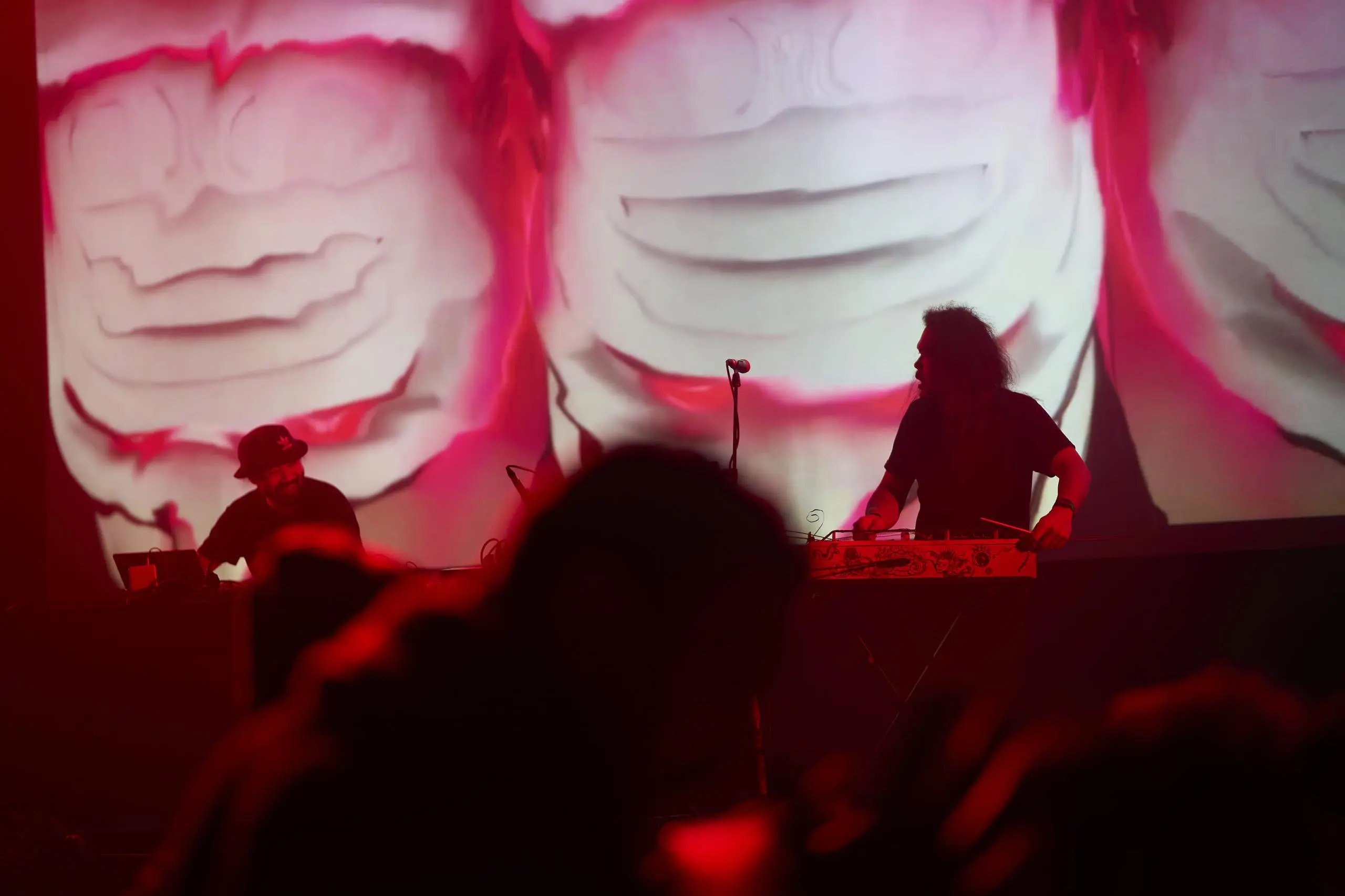
The second program, Pulse, made El Mediator (Perpignan’s SMAC, linked to the Théâtre de l’Archipel) resonate at the crossroads of electronic music and digital arts. “I love these crossovers between genres, says Franck Vigroux. It’s often there that the most stimulating proposals arise.” In terms of stimulation, the crown clearly goes to the Nippo-Indonesian duo Takkak Takkak, which treated us to a dizzying live A/V performance in maximum saturation, combining a sonic deluge of hardtech/breakcore and vibrant multicolored video creation in a mega-trip vibe akin to LSD.
The Aujourd’hui Musiques festival was held from November 12 to 21 in Perpignan.
